Tuesday, September 22, 2009

Namsan Mountain

Namsan (South Mountain), located near my hotel in Myeong-dong, is accessible by many different points of departure in the city of Seoul.

Like the Eiffel Tower in Paris, N' Seoul Tower -- located on the summit of Namsan -- became a symbol of Seoul when it was constructed as a broadcasting transmission tower in 1969.

When it first opened for public access, Namsan became a popular place for locals to hike and relax, with an outstanding 360 degree panorama from the mountain's peak. During the busy season, over 30,000 people visit Namsan.

On weekends, Namsan features a wide array of exhibits, and both performing arts and visual art displays -- like this human figure constructed of chicken wire (right).

The easiest and most scenic route to the base of the tower is by cable car. Daytime views are great when the sky isn't filled with smog or yellow dust, and the evening views are outstanding.

Namsan is one of two of the best places to appreciate the megalopolis of the Greater Seoul Metropolitan Area.


Seodaemun Prison

Within the Seodaemun Independence Park lies a prison constructed to house Korean independence fighters during the Japanese occupation between 1910 and 1945.

Seodaemun Prison, which includes seven separate prison buildings, features nightmarish punishment chambers and claustrophobic cellblocks. To add to the realism of this grotesque site, the prison has life-size Korean and Japanese figures complete with fake blood, ear-piercing screams and ingenious torture techniques.

The park also includes the Independence Movement Gate and Museum, the Martyrs' Tower and the March 1st Independence Movement Tower.

Seodaemun Prison is simultaneously interesting, barbaric, compelling and gruesome: not a pretty sight.


Seoul Grand Park

Opened in 1984, Seoul Grand Park now features one of the world's ten largest zoos. Set among the forested hillsides south of the city, a river runs through the park, and families picnic on its shady banks.

The zoo is home to numerous exotic creatures, including the most popular Asian and African varieties, and has a long list of breeding successes, including tigers and panda bears.

The facility, which compares favorably with large zoos in the United States, features cranes, swans, pelicans and other large birds. Ants and swimming beetles are on display in a "miniature creature" exhibit.

One of the highlights of the zoo is an elaborate "dolphin show" (right). The many facilities here also include a tropical greenhouse for flowers (bottom), a reservoir and walking trails. The indoor botanical garden houses a forest of cacti, numerous orchids and carnivorous pitcher plants.

Visitors who would prefer to ride rather than walk can take a tram that provides a stunning view of Seoul Grand Park.

"Seoul Land" possesses over 40 amusement park rides, and the National Museum of Contemporary Art holds ongoing exhibits. The latest addition to the complex is the National Gwacheon Science Research Center.

With -- really -- too much to see in merely one day, the facility is truly a "grand park."


Gyeongbokgung Palace

Gina (above) arrived at my hotel in Myeong-dong from Busan late on Thursday, September 17. She took an extra day off from her rigorous schedule teaching English to young Korean students, stretching her weekend to three days so that we could do a bit of sightseeing in Seoul together. First stop: Gyeongbokgung Palace.

At one time, the Gyeongbokgung Palace was likely a place of pomp and circumstance.

Today, the uniformly brown buildings with a dirt compound in front may leave visitors with the impression that the site is undergoing restoration work.

The Gyeongbokgung Palace was the country's principal royal residence until the compound was destroyed in 1592 during war with Japan.

However, it was not the Japanese who razed the palace but the citizens of Seoul.

As the Japanese marched across the country, the king and yangban (aristocrats) abandoned the city to save their own hides.

Angered by the desertion, a mob of local residents burned down the palace.

Gyeongbokgung lay in waste for nearly 300 years until it was rebuilt it 1865.

Today, Gyeongbokgung Palace has been restored to its former glory. Adjacent to the palace, the Seoul Museum of History provides visitors with an overview of Seoul's history and traditional culture.

A ceremonial changing of the guard (below) occurs several times a day, so clearly the pomp and circumstance has returned to Gyeongbokgung Palace.


Sogang University

On Wednesday, September 16, I hopped a cab to Sogang University for my lecture on healthcare public relations to a class of about 80 aspiring Korean public relations students.

The opportunity to lecture was facilitated by my colleague Dr. Kyu Ho Youm, a Korean native who is Professor and First Amendment Chair at the University of Oregon School of Journalism and Communication.

Founded in 1960 by the Society of Jesus, the mission of Sogang University is to provide students with an education based in Catholic belief and inspired by the Jesuit educational philosophy in conformity with the Korean educational tradition.

The university, with a 50-acre campus located in east-central Seoul, has an enrollment of over 15,000 undergraduate and graduate students and nearly 1,000 faculty members.

Arrived at Sogang University early and I'm glad I did: it took me a little while to get my bearings. Dr. Hochang Shin, a friend and colleague of Dr. Youm's, was my host.
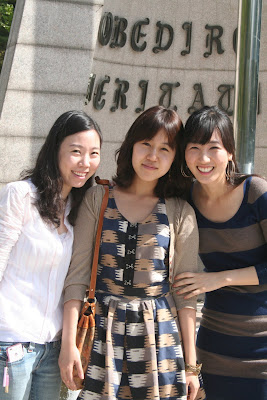
Meeting with several of Dr. Shin's teaching assistants (from left, Jihana Ko, Min-young Kim and Yeon Ji Noh), we proceeded to a nearby classroom where I delivered my lecture.

Had a delightful time discussing healthcare public relations: his students were attentive and inquisitive, and Dr. Shin was very gracious.

Turns out I didn't need an interpreter; they all understood English fairly well.

After my lecture, I opened the floor to questions and several students responded with great inquiries.

One of my favorites was the student who asked: "will there always be issues for healthcare public relations professionals to deal with?"

I explained to her that -- based on my experience -- yes. To quote Roseanne Roseannadanna on Saturday Night Live, "it's always somethin'."

Whether it's AIDS, West Nile Virus, H1N1 -- the list goes on and on -- there will always be a need for effective healthcare communicators: "job security for public relations professionals," I quipped.

Afterward, Dr. Shin treated me a lunch at a fine Korean restaurant across the street from Sogang University. Then, practically before I knew it, I was back in a taxi on my way to my hotel in Myeong-dong.

As I said before, eveything is very much hurry-hurry in these parts.


Monday, September 21, 2009

South Korea: Tiger or Teddy Bear?

Asian tiger, a seriously wired country, or a populace steeped in the morality of Confucianism? All are accurate descriptions of South Korea, yet none of these fully captures the essence of this fascinatingly complex -- yet contradictory -- nation.

Grounded in ancient Confucianism, the history of Seoul can be traced back as far as 18 B.C., when it was first established as a settlement. Of the South Koreans who profess religious beliefs, most are Buddhists or Christians.

Nonetheless, South Korea is definitely a forward-thinking country, thanks to its hurry-hurry approach to almost everything. New York may be the city that never sleeps, but Seoul is the city that never even slows down.

Koreans clearly have a zest for life, and face-to-face, local residents are pleasant and polite. However, on the streets of Seoul, you're on your own. Everybody is in a hurry to get somewhere, both pedestrians and motorists: there's no "stopping to smell the roses."

If I had to sum up South Korea in one word, it would be "dynamic." If I were to use two words, it would be "dynamic and conservative."

Seemingly contradictory, for many Koreans it's simply a matter of yin and yang.

Sunday, September 20, 2009

Where The Streets Have No Name

Getting around Seoul can be -- in a word -- confusing, even for foreign travelers who can speak Korean.

One reason for the confusion is simply that Seoul is so big, both in terms of area and population. Lots and lots of urbanites with things to do, places to go and people to see.

Another reason, as U2 (one of my favorite rock bands) sings about on their classic "Joshua Tree" album, is that the streets have no name.

In case you're wondering: no, I'm not kidding. The streets really have no names. Mapquest is of little use. You better know where you are going and be able to explain it to your Korean taxi driver.

Oh, the city of Seoul has directional signage (above), but it doesn't help much. Finding your way around Seoul reminds me of a line from "The Point," an animated story conceived by Harry Nilsson:

"A point in every direction is like no point at all."