Sunday, February 13, 2011

Planet Of New Orleans

Editor's Note: In the first of hopefully many future retrospectives in GonzoKaleidescope (the feature promised in a press release in this space almost a year ago), the following was a review of Gonzo's first trip to New Orleans during Halloween Week in 2003. In anticipation of the culmination of Mardi Gras on Fat Tuesday, March 8, here's a reprise of an article originally written for the UO PRSSA newsletter.

After the six-hour flight from Portland, my goal was to get to my room at the Radisson New Orleans, which doubled as the 2003 Public Relations Student Society of America National Conference Headquarters, as expeditiously as possible. Little did I know that my wait in line at the hotel registration desk would rival my flight time from the City of Roses to "The Big Easy," as it has come to be known.

Arriving at the Radisson on Canal Street in the French Quarter, a smartly-dressed bell-hop in full uniform, complete with matching hat, shirt and short pants greeted my with a jovial "may I carry your bags, sir?"

Since the doors were glass, it was clear that the line for the registration desk extended all the way to the hotel entrance. "No thanks," I replied. "I think I have everything under control."

What transpired next was very likely my longest wait ever to secure a hotel room. After two hours of waiting alongside increasingly disgruntled students, some of whom were left without a room despite having reservations, I finally received a key card to my room.

Our student contingent from the University of Oregon was less fortunate than I. After a long wait, they finally did receive key cards to their room. There was just one problem. When they went to their room, another group of students were already there. "You're the second group they've sent up here," they were informed.

Who would have thought life could be so hard in "The Big Easy?"

The problem, we ascertained, was twofold: overbooking and a major hotel remodeling project virtually guaranteed chaos in this highrise adjacent to the French Quarter.

In hindsight, I was lucky I only needed a room for myself.

My UO students persevered and prevailed, checking into a nearby Comfort Inn. However, their new berth would cost more, which could be an issue when reconciling expenses.


The next morning, at a conference session entitled "effective crises communications," we collectively took note when the speaker told the group of young public relations professionals that they need to "stay out in front of a crisis."

"Did the Radisson believe that a lack of available rooms, slow banquet service and various other problems would go unnoticed among the hundreds of public relations students from across America?" I asked myself.

"Didn't the management realize that these very same students would someday become public relations professionals with a choice of where they might want to stay during a business trip or vacation, and that they not only likely wouldn't choose to stay at the Radisson, but that would tell all their friends about their experience?"

Later that day at noon, after dealing with yet another tediously long wait for lunch, we pointed out the hotel's "public relations problem" to the PRSSA organizers. "We just wanted you to be apprised of our situation," noted Taraneh Foster, the most vocal in the group of UO students, "just in case PRSSA is named in any lawsuits over our failure to secure a room when we had reservations."

To its credit, the PRSSA National Conference Committee -- noting that it was indeed a public relations problem for the hotel -- agreed to cover the extra expense for the room at the Comfort Inn, and said the hotel would publicly acknowledge the problems.

The whole issue provided a real-life case study in crisis communications, with good news on two fronts. The UO PRSSA students could be assured that they wouldn't have to dig deeper for the extra dough for their room during the conference. And the Radisson would offer its regrets to all the PRSSA delegates at one of the general sessions, though none actually witnessed the "mea culpa."

I think we were all down in the French Quarter checking out the planet of New Orleans.

Standin' on the corner of Toulouse and Dauphine, waitin' on Marie-Ondine. I'm tryin' to place a tune under a Louisiana moonbeam on the planet of New Orleans.

In a bar they call The Saturn, and in her eyes of green, and somethin' that she said in a dream. Inside of my suit, I got my mojo root and a true love figurine for the planet of New Orleans.

New Orleans, the other planet, with other life upon it, and everything that's shakin' in between. If you should ever land upon it, you better know what's on it, the planet of New Orleans.

-- Dire Straits, On Every Street

Saturday, January 15, 2011

Everybody Duck

It was -- for the University of Oregon football team and Duck fans around the world -- a season for the ages.

On Monday, January 10, the Ducks slugged it out with Auburn University, the champions of the Southeastern Conference, in the apex of the college football world, the BCS national championship game. Contrary to conventional wisdom that pointed to a high-scoring affair, the game defied the form chart with a defensive donnybrook.

The exciting and tightly-contested outcome had to please both ESPN executives and advertisers alike. Viewed in millions of American homes on ESPN, the game would not only become the highest-rated program in the network's history, but the highest-rated cable television show ever with a 16.1 rating, according to Nielsen.

Pac-10 champions for the second straight year, Oregon battled toe to toe with Auburn for four quarters, but the Tigers eked out a 22-19 victory with a field goal at the buzzer. Despite the loss, Duck fans everywhere can be proud of their team: the University of Oregon finished the regular season with a 12-0 record and became one of the few to ever win the conference with an undefeated record.

And most were. However, the malcontents emerged almost immediately after the game with their vindictive, spiteful venom. Said one Register-Guard poster, signed "Donald Duck" (a pseudonym):"Two years in a row, and I must admit that (Duck football coach) Chip Kelly choked. Last year, it was the Rose Bowl: this year, the national championship. Chip is simply not ready for prime time. Sad, sad, sad."

Sad? The best season ever in Duck football history? You must be kidding. I have little patience for such sentiment.

Fair-weather fans like "Donald Duck," who only seem to be increasing in their numbers, clearly lack perspective. For those of us who have been following Duck football since they had only two sets of uniforms, there's a lot to like about this program.

It's been a long road from the outhouse (the Toilet Bowl, also known as the 1983 Civil War, the last 0-0 tie in college football history, an exercise in futility that included double digit turnovers and no points) to the penthouse (the BCS national championship game).

I first started following the Ducks in the 1960s, toward the end of the coaching reign of the legendary Len Casanova. My parents both attended the University of Oregon during their freshman year in college, though they both finished their degrees in the City of Roses, at the University of Portland and Marylhurst College.

The Ducks would play the occasional football game in my hometown of Portland, usually against USC, Oregon State or Washington. Hayward Field on the UO campus in Eugene only held 22,000, while Multnomah Stadium in Portland held 35,000, so it made more financial sense to play some games in the larger venue.

During my college years in the early '70s, the oft-coined expression by inebriated students was "the Ducks suck!"

That was the extreme view, not unlike our aforementioned "Donald Duck," the erstwhile fan.

However, despite all the adversity we faced as Duck fans, we always loved our Ducks, win or lose. I always believed that being a Duck was more real life. In real life, you don't always win.

During one Duck football game in the early 70s, a particularly excruciating loss to Cal, I turned to my j-school classmate, Jeff Foreman, and asked: "do you think we will ever go to a bowl game in our lifetime?" He shook his head "no."

Right then and there, we made a blood pact that if the Ducks ever were to go to a bowl game, we would be there to support our team -- anytime and anywhere.

About 14 years later, in 1989, the Ducks were invited to the Independence Bowl in -- of all places -- Shreveport, Louisiana. Jeff and I met my brother Robert, who flew in from Philadelphia, at the bayou bowl game.

Down two touchdowns in the third quarter, the Ducks rallied to win behind the passing of quarterback Bill Musgrave for the 27-24 win over the University of Tulsa Golden Hurricane.

With that modest success, the Independence Bowl would lead to bigger and better bowls. In 1990, we actually went to a warm weather bowl in Southern California, the Freedom Bowl.

After a couple of down years, some fans started grousing; they wanted to fire Head Coach Rich Brooks.

"Ditch Rich" signs were ubiquitous in the Autzen parking lot after the Ducks started the season 1-2 in 1994. But both Coach Brooks and the Ducks responded to their critics by finishing the season with a 8-1 run to win the league title outright and punch their ticket to Pasadena.

The University of Oregon would represent the Pac-10 Conference in the Rose Bowl, their first trip since 1958, and face the Penn State Nittany Lions in the "granddaddy of them all."

In 2001, the Ducks played in their first BCS bowl game, stampeding the University of Colorado Buffaloes and finishing as the #2-ranked college football team in the country.

Over the next 10 years, the Ducks appeared in a succession of lower-tier bowls until 2009, when they returned to the Rose Bowl, and this year, when they played in the BCS national championship game.

Aside from the game itself, there was a lot to like about the Ducks' first appearance in the big game. This season -- even with the loss to Auburn University -- was a victory.

The collective awareness of the University of Oregon generated by all the media attention during the 30-plus days of coverage leading up to the game is incalculable -- it would be virtually impossible to buy that level of exposure. Major coverage, in a very positive way.

And as they say: "a rising tide lifts all boats." The game not only helped raise the profile of the football team, but the University of Oregon itself. The Ducks were "feelin' the love" from sea to shining sea, and even Jimmy Fallon weighed in on the subject on his show.

And, like it or not, the Ducks have become the gold standard of college football. Oregon is now one of the top ten programs in the nation: they are successful, they are recognizable and they are in a position to stay there.

It's been a long and winding road from Shreveport, Louisiana to Glendale, Arizona. And to those "nattering nabobs of negativism" (the fair weather Ducks like "Donald Duck," the aforementioned Register-Guard poster), I say this: loyal fans of the University of Oregon will always love their Ducks -- unconditionally.

As Head Coach Chip Kelly says: "we'll be back," and Duck fans have every reason to believe him.


Thursday, December 30, 2010

Mac Court Memento

We bade farewell to McArthur Court -- home of the University of Oregon Ducks -- over the New Year's holiday weekend by attending the last two UO men's basketball games scheduled to be played in the venerable, iconic and much-beloved arena (above).

The 84-year-old gymnasium, one of the great venues in college basketball lore and the third oldest on-campus facility in the country, will soon be replaced by the state-of-the-art Matthew Knight Arena funded in part by Nike founder Phil Knight.

Mac Court has hosted more than 1,500 men's and women's basketball games, countless volleyball, wrestling and gymnastics matches, and college and high school basketball tournaments. Built in 1926, the facility was designed by Ellis Lawrence, noted campus architect and longtime dean of the School of Architecture and Allied Arts.

"The Pit" as it came to be known, was named for Clifton "Pat" McArthur, a former UO student body president and member of Congress from Oregon. In addition to sporting events, the arena has also featured visits by presidential candidates ranging from Robert Kennedy to Barack Obama, musicians from Elvis to The Grateful Dead and comedians from Bob Hope to George Carlin.

As a longtime season ticket holder to UO men's basketball (the view from our seats, above), I have spent a considerable amount of time at Mac Court over the years. But my first visit was not to attend a basketball game, a concert or a political rally; it was to register for class as a new student at the University of Oregon.

In my day, registration for classes at Mac Court was -- in a word -- nutty. Students were assigned times and had to sit in the bleachers to wait their turns. As you might expect, underclassmen always went last and when your number came up, you had to virtually run from table to table to register for classes. Class status and availability were posted on a large scoreboard (above).

Of course, most of the popular classes were filled by the time you got there, so you'd better have a back-up plan. The whole experience was not unlike an ant farm, with students climbing over one another to get that class they really needed to graduate. The only upside to the whole process was that it was a good way to meet girls.
By the time I arrived in Eugene, the UO basketball team had become so popular that it was hard to get tickets to games, even if you were a student. But one fateful day in February, 1974, I took a call from an old girlfriend -- a fellow UO student who lived in a sorority on campus. She bemoaned the fact that she had to travel to Portland for the weekend and asked me if I wanted her ticket to the UO-UCLA men's basketball game.
"Hell, yeah!" I remember saying, and soon I would be attending my first UO men's basketball game in Mac Court. This would be no ordinary conference game, however.

The Ducks were playing the mighty UCLA Bruins, darlings of the college basketball world, winners of 88 straight games (a record which was only just recently bested by the University of Connecticut's women's basketball team) and the No. 1-ranked team in the country.

If that wasn't bad enough, our buddies up the road in Corvallis -- the Oregon State Beavers -- had upset UCLA two nights before. Surely the Bruins would take out their frustrations on the Ducks.

But Oregon was no cellar-dweller that year. Coached by Penn legend Dick Harter, the team featured the "Kamikaze Kids," a scrappy group of players known for their swarming defense and reckless abandon. With future NBA players Ron Lee (below, #30) and Greg Ballard (below, #42), these guys led the league in floor burns and would prove a formidable opponent for the prima donnas from La-La Land.

My impression of Mac Court would forever be shaped by that first game. Before tip-off, the cheerleaders whipped the crowd into a frenzy. During the course of the game, Mac Court rocked so loudly that you could barely hear yourself think; the scoreboard swayed from the stomping and screaming of 10,000 fans. The Pit had its own pulse and you could feel the beat with every fiber of your being.

UCLA jumped to an 11-2 lead, but nobody panicked; UO found ways to break the Bruin press and the Ducks led at halftime. UCLA made a run in the second half, taking a one-point lead, but ultimately they could not stop the collective will of Ronnie Lee, his band of kamikazes and the Mac Court crowd. At the final buzzer, the scoreboard read 56-51 in favor of the Ducks and pandemonium ensued.

Sport Illustrated reporter Kenny Moore -- a UO grad -- wrote "(UCLA Coach) Wooden got his players through the melee, and when the floor cleared in an hour or so, it was slick with tears of deliverance." On that day, I became a true believer in the mystique of Mac Court.

This place was a bonafide home court advantage and students and fans were genuinely passionate for their beloved Ducks. Moving back to Eugene for graduate school, we naturally purchased season tickets (hey, what else can you do in Eugene during the rainy winter season?).

I have many other Mac Court memories including watching a bloated Elvis in his white jump suit belting out his hits just months before his death.

Mac Court was also the site of a 1984 visit by Gonzo journalist Hunter S. Thompson (right), who held court among hundreds of admiring students. I shot several rolls of film at that event (below, in a shot taken by my brother Robert's roommate Ray Bell) and they turned out so well, despite Thompson's manic ramblings, that I had a number of them framed.

Years later, Thompson returned to Eugene, this time at the Eugene Hilton.

Knowing Thompson's penchant for tardiness, longtime friend Tom Maloney and I attended a Duck basketball game at Mac Court prior to heading to the Hilton. Hoping for a autograph on one of my framed shots, I handed Thompson the picture. "Great shot, eh?" he blurted. "Reminds me of my glory days." He then handed the print to his bodyguard and ordered him to "put this with the other stuff."

Naturally, I was upset. As a consolation prize, he signed my Oregon basketball ticket with a hastily-scribbled "HST." Much later, in hindsight, my disdain with Hunter S. Thompson was replaced by a sense of honor that he thought enough of his portrait to confiscate it.


With too many memories of Mac Court to recount in this space, I'll wrap up this blog post by noting two other significant events.

Mac Court was the site of both my graduation ceremony and that of my daughter, Gina, (above, middle) who is pictured here at one of the entrances to Mac Court with fellow University of Oregon School of Journalism and Communication classmates Hannah Smith (left) and Beth Evans (right).

So it is not without a bit of nostalgia that we say "farewell" to beloved McArthur Court. It is, as the man says, the end of an era. As singer/songwriter Jackson Browne would lament:

All good things got to come to an end,
The thrills have to fade, before they come 'round again,
The bills will be paid and the pleasure will mend,
All good things got to come to an end.


Sunday, December 19, 2010

Much Ado About Goomsba


To the editor:

The December 15, 2010 issue of The Leavenworth Echo featured a great cover story by Nevonne McDaniels on the Woody Goomsba promotional video. It was a balanced, objective treatment of a subject that occasionally lends itself to controversy: the art and science of advertising.

Of course, once I read the story, I had to check out the video. My impression? The video is very creative, and Howell at the Moon Productions should be congratulated on a job well done. However, some fuddy-duddies in the Bavarian Village are not so easily impressed. But “outrage” concerning “damage done to Leavenworth’s reputation as a family destination?” And “scantily clad women?” Let’s not go overboard here. These folks need to lighten up.

As someone who has worked in the field of advertising, promotion and media relations for over 30 years, I can tell you that advertising professionals walk a fine line in communicating their messages. First and foremost, advertisements must be creative enough to grab attention; but they cannot be boring or -- by and large -- offensive.

The key to effective advertising, however, is whether the messages communicated reached the intended target audience, in this case, the under-30 crowd. Hate to break it to some of the folks on the Leavenworth Area Promotions committee, but they are not the intended audience for the video. At least one member of the committee readily admits that fact: “To be honest…I don’t click on Facebook and those kinds of things.”

So, did the Woody Goomsba video attract the attention of its target audience in a creative way? With nearly 150,000 hits as I write this letter, I’d say “yes.” The media attention generated by the promotional video is clearly a bonus.

My hat is off to the innovative members of the LAP committee for taking a creative approach to reach an untapped audience, one that will be vital in an effort to sustain economic development in the Bavarian Village and vicinity into the future. As for the negative reaction, just remember that opinions are like birthdays: everybody has one, especially when it comes to advertising.

Saturday, December 18, 2010

Birds Of A Feather

Okay, so I lied; however, I have a good excuse, and this is coming from someone who has heard a few from students in his day.

As a long time Duck fan -- and despite the claim that my most recent post would be the last of the year -- I couldn't pass up the opportunity to comment on the subject of the run by the University of Oregon football team to the BCS national championship game against Auburn University in Glendale, Arizona on Monday, January 10.

Receiving an invitation to witness history in the 2010 Civil War from Mat Northway, my former supervisor at Eugene Water & Electric Board, we ventured north to "the belly of the beast" -- Reser Stadium in Corvallis, home of the Oregon State University Beavers. Mat (a loyal Beaver fan), in a genuinely altruistic gesture, invited two other EWEB Duck fans (Tommy Williams and P. Steve Stuart) to the game as well.

Arriving at the the stadium (below) early to witness "senior day" festivities, the weather was as good as you could hope for a Civil War in December -- mostly sunny and in the low 50s. Mind you, most Civil Wars are conducted in a cold, blinding rainstorm with high winds.

The Beavs jumped out the a quick lead after taking advantage of a Duck turnover to make it 7-0. OSU fans were fired up -- particularly the Beaver gal with the shrill voice directly behind me -- and it looked like the Oregon State football team came ready to play despite a 38-0 drubbing by the Stanford Cardinal the week before.

But, as has been the case all season, the Ducks soon took control of the game, refusing to let a few turnovers ruffle their feathers. By halftime, the Ducks led 19-7 and by the fourth quarter, UO had a three touchdown lead over their in-state rival. Beaver fans (below) could see the writing on the wall; the Beaver booster behind me had already retreated to her tailgate party to drown her sorrows.

So, after years of futility and then gradual improvement, the undefeated University of Oregon "Fighting Ducks" will play in the national championship game. It's been a long and windy road from the Toilet Bowl (the 1983 Civil War, the last 0-0 tie in college football history) to the more recent trend of Civil Wars that actually mean something. For that matter, it's been a long ways from Shreveport, Louisiana (the 1989 Independence Bowl, the first postseason appearance for the Ducks in 26 years) to Glendale, Arizona.

Because tickets to the game are both hard to get and expensive (and because we are only entitled to two as season ticket holders), my "partner in crime" at Duck football games -- Randy Enders -- will be taking his Dad to the championship contest in Arizona. For me, I'll watch the game on television and content myself with thoughts of the memorable home games and the historic Civil War that I witnessed in this magical season. Go Ducks!


Friday, December 3, 2010

Write Stuff, Right Time

Faithful readers, I will be taking a short hiatus from my blog during winter break at the University of Oregon School of Journalism and Communication in December to continue work on my novel.

Due to the start of a three year process to renovate Allen Hall (above), home of the School of Journalism and Communication, the adjunct offices have been moved to the UO Annex (below) on 12th Avenue near Kincaid Street, in the same block as Rennie's, a popular campus watering hole, and the UO Bookstore.

The building, an old dormitory from the same era as the Animal House, is turning out to be a nice location. Close to Barry's Expresso and a variety of eateries in the neighborhood, the UO Annex is a quiet spot to work, even when school is in session. During winter break, it should be the ideal place to get some serious writing accomplished.

Have a great holiday season and see you in January. Go Ducks!

Tuesday, November 23, 2010

King Of The Blues

"I'm 85 years old, and I'm still singin' the blues." That's how B.B. King introduced his show at the Hult Center for the Performing Arts in Eugene on Tuesday, November 3.

Rebecca, Jory and I picked up some last minute tickets in the front row of the upper balcony section at the Silva Concert Hall.

I had considered going for awhile, but at the last minute, I thought I should take advantage of the opportunity to see B.B. King once again considering his age and his status as a longtime diabetic. I've seen him maybe a half dozen times over the years: the first time was at Springer's Ballroom in the hinterlands of southeast Portland in 1969.

It was a great show. His band, which included keyboard, drum, lead guitar, bass, baritone sax, tenor sax and flugelhorn, was tight. B.B. was good for about 90 minutes, then he signed off. I only hope I can do that well at his age.

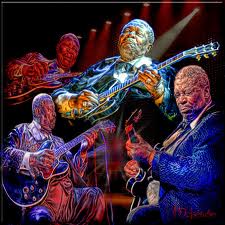
Noting that he was 85, I realized he would have been 44 when I first saw him in concert as a 17-year-old blues neophyte. At left is a portrait of the artist as a young man. B.B. was named #3 on Rolling Stone's list of the 100 greatest guitarists of all time.