Tuesday, September 13, 2011

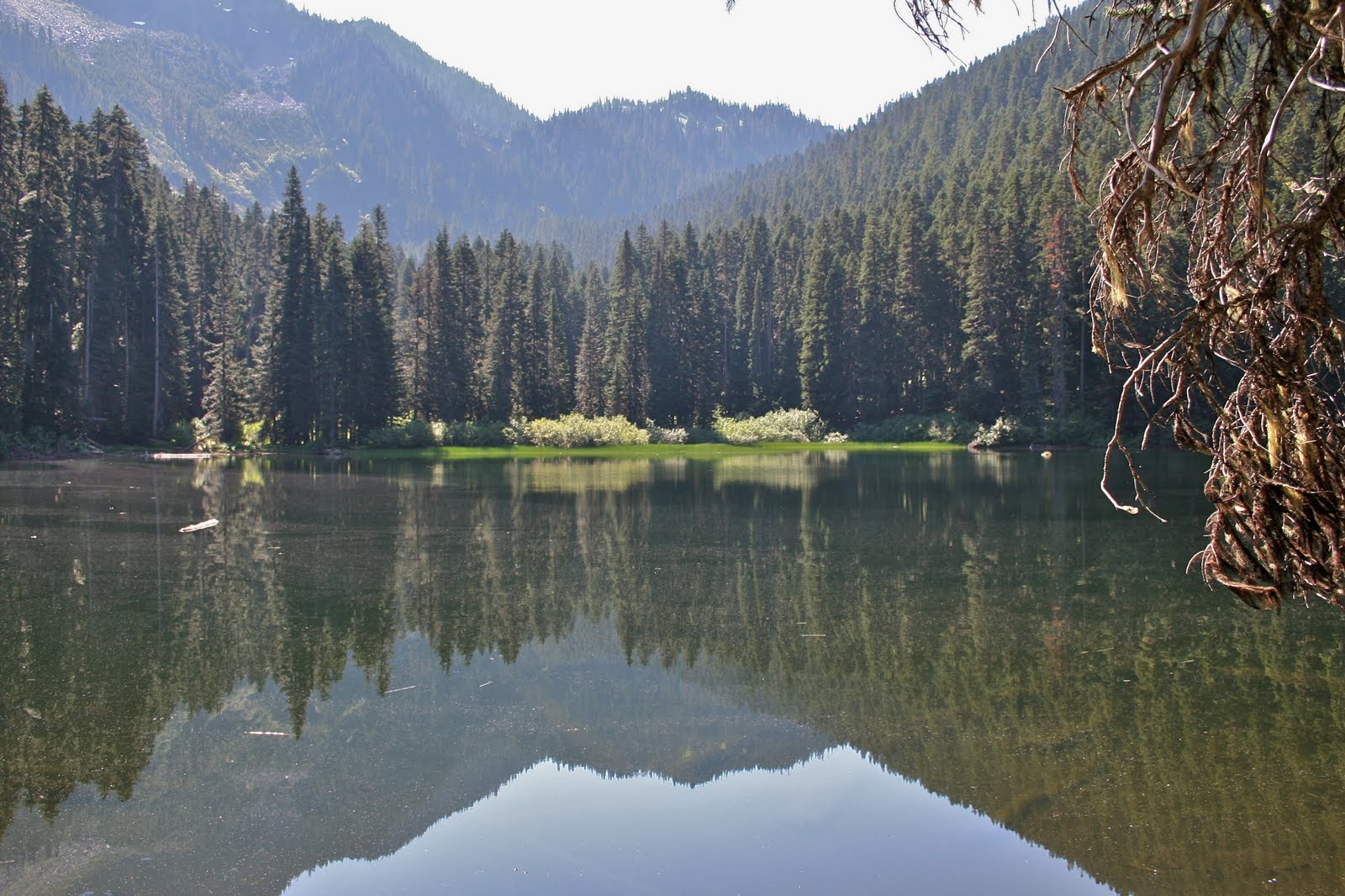
Lanham Lake

Located just east of Stevens Pass, Lanham Lake (above) sits at the base of Jim Hill Mountain, one of two peaks in the area (the other being Big Jim Mountain on Icicle Ridge) named for James J. Hill, the Great Northern Railroad empire builder.

Trail mate and friend Chuck Ferguson and I hiked the path to the lake, which ascends a steep slope in some big timbers on the Whitepine Creek/Mill Creek divide, on Friday, September 9.

The trail winds through a primeval forest complete with Devil's Club (above), also know as "Devil's Walking Stick." Devil's Club generally grows to three to four feet tall, but can reach a height of 16 feet in rainforest gullies like the Napeequa River.

Some years back, a group of us were dispatched up the Napeequa River, which lies in the Glacier Peak Wilderness, to destroy a squatter's cabin several miles up the river on Forest Service land.

The Devil's Club was over 10 feet tall and -- along with huge patches of vine maple and groves of huge old growth western red cedar -- the scene resembled a prehistoric set straight out of Jurassic Park; I kept thinking I might see a triceratops or a pterodactyl at any moment.

Devil's Club is one shrub you don't want to grab during your walk in the woods. This primordial plant has long, nasty stickers awaiting unsuspecting hikers looking to steady themselves.

As we proceeded up the trail, we crossed through a huge blowdown of large timber across the trail. Chuck said the trail crew has spent days logging out the mess of mountain hemlock and western red cedar that resembled a pile of pick-up sticks.

The cut wood created some interested patterns of pitch (above) that filled the air with a wonderfully pungent aroma.

Our stay was relatively brief considering the amount of time we had spent hiking to Lanham Lake, but the black flies were in fine form, so we took a few pictures and then headed back to the trailhead adjacent to the Stevens Pass Nordic Center.


Saturday, September 3, 2011

Old School

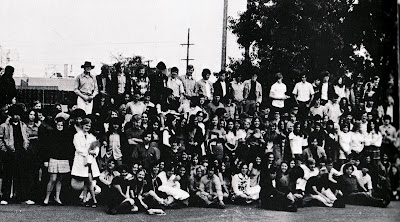
On Sunday, August 21, I spent the day in Portland attending my 40th high school reunion with about 80 of my former classmates from the Lincoln High School Class of '71 (above: that's me in the bottom right, with legs extended in my kick-back-and-relax position).

Although I spent my freshman and sophomore years at Jesuit High School in Beaverton, I transferred to Lincoln -- the oldest high school in the Pacific Northwest -- for my final two years. Established in 1869, Lincoln High School is located in downtown Portland across the street from the iconic Multnomah (now Jen-Weld) Stadium.

To say that Lincoln was a complete switch from Jesuit might be the understatement of the year. An all-boys school, Jesuit prided itself on its academic prowess, which was considerable. Very regimented, the school was governed with a tight grip by the "soldiers of Christ," those priests and noviciates of the Society of Jesus who served as teachers, administrators and coaches at the school. Lincoln, on the other hand, was fresh, progressive, loose, diverse and -- well, let's face it, folks -- less difficult than Jesuit.

It was a better fit for many like myself during the turbulent '60s, when baby boomers came of age following the assassination of President Kennedy, his brother, Bobby and Martin Luther King, along with the Free Speech Movement and Vietnam protests. Plus, there were girls!

Speaking of old schools, the reunion was held at Kennedy Elementary School, another old facility founded in 1915 in Northeast Portland. Owned by those Northwest brewmeisters, the McMenamin brothers, the school is now a popular microbrewery and watering hole that features a movie theater and hotel.

The reunion started at noon, and my goal was to connect with as many people I didn't know in high school as possible -- as well as many I did know. Though well-intentioned, I'm sorry to report that I was unsuccessful in talking to everybody, but I did have have the opportunity to catch up with many of my former classmates.

My high school reunion was, appropriately, quite educational -- a most enjoyable learning experience and one I won't soon forget.


Thursday, September 1, 2011

Fire In The Sky

After returning from our "challenge of the Chiwawa," which included exploring the headwaters of the Chiwawa River at its start at the base of Fortress and Chiwawa Mountains (above), Steve and I spent a couple of days of rest, respite, recuperation and reorganization at Owl Farm near its junction with the Wenatchee River (below).

There's nothing better for the body and soul than a shower and a sauna after several days in the wilderness, along with the requisite bottle of port, Dirty Face pizza from Headwaters Pub and a movie on the laptop. Even an errant mosquito or two couldn't spoil our glow.

Before our departure back to Oregon, a forest fire broke out on top of a ridge overlooking Tumwater Canyon. The 500-acre blaze closed U.S Highway 2, which follows the Wenatchee River down to Leavenworth.

As a result, traffic from Seattle was rerouted through Plain down Washington State Route 209, creating a long procession on our way south, at least as far as the Bavarian Village.

U.S. Forest Service personnel, including nearly 300 firefighters and air support, were everywhere. The scene resembled a battle front. As I was wheeling down the road, the memories of my days as a forest firefighter were as thick as the smoke in the Chumstick Valley: the adrenaline rush from a fire call, grabbing our fire packs not knowing how long we'd be gone, and perhaps a quick phone call to a loved one.

Then there was that unmistakeable smell. Smoke, yes, but as a former forest firefighter, I'm talking about the smell of money.

Wednesday, August 24, 2011

Chiwawa Basin, Day 3: A Bug's Life

Steve and I awoke at our camp no worse for wear on Monday, August 15, other than some sore quads and a few nasty bug bites. The plan was to head down the trail toward Trinity on our way out to Owl Farm before the bugs became too active in the warm summer sun.

In order to see some of the stunningly beautiful sights in the wilderness, like the view of the upper Entiat Range (above), you need to come to terms with the fact that you'll be dealing with bugs. Just like your friendly neighborhood vampire, all they want is your blood.

The first nasty insects to appear during the long bug season in the woods are ticks, which tend to follow the snow line in late spring. Ticks were a regular occurrence during our tree planting days back in the '70s during March and April and it was always a good idea to thoroughly check yourself at the end of the day.

Annoyingly ubiquitous, mosquitoes (left) are the next bugs to appear on the scene. Their numbers can rival black flies in forested backcountry areas.

The good news about mosquitoes is that "bug dope" with DEET (diethylmetatoluamide) can deter the bloodthirsty buggers, which are fully capable of swarming unsuspecting hikers in the backcountry. The bad news is that they are the only blood-sucking bug among many varieties of wilderness pests that really responds to DEET.

Probably the nastiest insects in the backcountry -- based solely on their sheer numbers -- are black flies (right). A common nuisance in mid-summer, black flies are actually attracted to DEET, so bug dope is of little consolation. Worse, black flies can swarm unsuspecting backcountry travelers, looking for any orifice available.

I can't tell you how many black flies I've swallowed whole while breathing with my mouth open on precipitous slopes back in my wilderness ranger days in the Forest Service. And don't let their resemblance to the common house fly fool you. When finally in position, they bite hard and it hurts.

Deer flies are also common at higher elevations in mid-summer, as Steve (above) discovered on our way back down the trail from Red Mountain, when one crawled up his pant leg for a bite to eat. Considerably larger than black flies, deer flies (below, right) have gold or green eyes, giving them that unmistakeable "alien" look.

Their bite can be extremely painful. Steve thought he had been stung by a hornet, but I assured him that it was a deer fly.

Last to appear on the backcountry scene -- usually in the "dog days" of summer in August -- are yellowjackets and bald-faced hornets. Yellowjackets tend to build their nests in the ground while bald-faced hornets (below, right) construct their homes in trees.

Both are quite nasty and their stingers are extremely painful. Aggressive predators that prey on other insects, they should be avoided at all costs.

So as we headed back down the Chiwawa River Trail to Trinity and Base Camp Juan, we were left with many reminders (read: bug bites) of our backcountry excursion. It's part of the price you pay to see such spectacular wilderness scenery (below).

For bug-free hiking, try September or October. The first couple of freezes at higher elevations take the bugs out of commission, except for the occasional -- and somewhat woozy -- yellowjacket.


Tuesday, August 23, 2011

Chiwawa Basin, Day 2: Red Mountain

On Sunday, August 20, Steve and I rose early to get a jump on our hike (and the bugs) up Red Mountain (above), a 7,646-foot summit of primarily historic interest on Phelps Ridge, which separates Chiwawa Basin from Phelps Creek and Spider Meadow.

Early miners called it "Red Hill" and pioneers such as "Red Mountain Ole" worked claims on its slopes in the late 19th century. Red Mountain stands out among the other peaks in the upper Chiwawa River area because of its striking appearance: the weathering of disseminated pyrite produces its bright red coloring.

The summit trail follows an old wagon road for a couple of miles. The plan was to veer off the trail near its junction with the Phelps Ridge trail and bushwhack our way to the top from the southwest. Because it's been such a late-developing summer, many mountain flowers were in bloom, including the western wood anemones (above), framed nicely by red berries on the mountain heather.

Unfortunately, we missed the junction, which had no sign or even a cairn to mark the way. In other words, we took a wrong turn at Albuquerque (as Bugs Bunny might be inclined to say) and continued on the Red Mountain road, passing an air vent (below) for the two-mile long Trinity tunnel buried deep beneath us in Phelps Ridge.

So instead of climbing our designated peak, we proceeded to the ridge between the east arm of Chiwawa Mountain and the jagged, precipitous cliffs on the north side of Red Mountain. Walking surfaces, which ranged from snow and ice to boulders and scree, were difficult at best. However, we were rewarded for our perseverance when we reached the ridgeline.

My, what a view! To the west, Glacier Peak (below) leered at us over Massie Ridge, lording over the lesser -- though not insignificant -- Fortress Mountain. To the southwest, Buck Mountain stood out as a lone sentinel, guarding the old mining community of Trinity.

To the east, the upper Entiat Mountains feature several 9,000-foot peaks, including Mt. Maude, Seven-Fingered Jack and Mt. Fernow. To the north, the views reach into upper Lake Chelan, with Bonanza Peak (bottom left, in the background) dominating the skyline.

After a brief rest and some pictures, Steve and I hastened our way down the mountain and back to camp because of waning daylight and dubious weather on the western horizon.


Monday, August 22, 2011

Chiwawa Basin, Day 1: Trinity Mine

The trail to the basin below Chiwawa Mountain (above) begins at the old mining development of Trinity, situated deep in the North Cascades. So on Saturday, August 20, Steve and I drove the 25-mile Chiwawa River Road to its end at Trinity.

Now a virtual ghost town, Trinity once was home for over 300 men and women employed by the Royal Development Company of New York in its heyday -- the 1920s and 1930s. In those days, the residents of Trinity had high hopes of "striking it rich."

Today, however, Trinity has been reclaimed for the most part by Mother Nature, who dumps an average of 14 feet of snow on the town site annually.

Destroyed by fire or crushed by the weight of many years of snow, most of the original 38 buildings are now gone. What remains are a few residences (left) and the generator plant.

Beginning in the 1890s, a number of companies -- including the Chelan Mining Company -- established claims in the area for silver and gold. Most failed to find anything of value and ceased operation. Then, in 1918, F.J. Naughten, a stockholder in the Chelan Mining Company and a Roman Catholic priest, hired mining engineer P.J. Lonergan, who determined that there was little silver or gold at the site but significant amounts of copper.

Father Naughten then recruited his brother James, a miner from Montana and, together with Lonergan, formed the Royal Development Company. Mining operations commenced immediately, but heavy snowfall and avalanches in the narrow Phelps Creek valley forced them to abandon work in the winter.

The solution was to blast a 11,000-foot tunnel into the side of Phelps Ridge (below) which would provide year-round access to the ore. The Royal Development Company sold stock to fund the mine. A hydroelectric project, first on nearby James Creek and later on the larger Phelps Creek, would provide power to the town and the mine.

But in 1938, the mine closed permanently for economic reasons; apparently, the ore was not of sufficiently high grade to continue mining. However, several old-timers associated with Trinity had other perspectives, which they shared with me for a magazine article I wrote for a Seattle-based recreational journal back in 1982.

Mildred Naughten, wife of James and proprietor of Parkside Grocery at Lake Wenatchee in the 1970s, said she and her husband were excited about the prospect of mining vast deposits of copper, gold and silver. But W.O. (Bill) Burgess, another old-timer, noted that the mine was built "totally on speculation." In other words, the investors were protected but the miners were not.

But hopes were high, based on continued investment by the Royal Development Company. This optimism was accentuated by the fact that the Roman Catholic Church had, in part, financed the mine. Naughten said the town site was booming despite the Great Depression, and many new buildings were constructed, including a mess hall, sawmill and residences, with more in the planning stages.

Then, one fateful autumn evening in 1931, the news came across the wire from New York City: the Royal Development Company had ordered the mine closed. They gave no explanation for the closure.

Naughten explained that many of the miners -- immigrants from Eastern Europe -- had recently come to work at Trinity. They had spent what little money they had stocking up on groceries and goods for a snowbound winter of anticipated work. Suddenly, they were out of a job and they were mad -- real mad.

"That night, they started drinking," Naughten reminisced, noting that the group of immigrants soon became a howling mob, violently angry because the main office had closed the mine for what the miners perceived as a "phony financial reason" rather than a lack of ore. She said they "went on a rampage," breaking windows and otherwise destroying company property.

"All of them had their wine, and they became unruly," said John Hendrickson, another old-timer who worked at the mine. "Liquor was a precious commodity in this remote community." One winter, he remembered, a man attempting to bring in a case of whiskey got lost in the deep snows and died in the woods leading to Trinity. "They didn't find his body until the following spring," he noted.

"This really was a struggle between those who were operating the mine and those who were financing the mine," said Naughten. The financiers -- all Easterners -- could care less about the mine, she said. All they wanted was to get hold of the money set aside for investment in the mine. The angry miners sensed this undercurrent, so they took their frustrations out on the company.

"I guess they took their vengeance out by smashing buildings," recounted Naughten. "It was really frightening. You just don't know how far a mob will go under the circumstances. It was sickening news for people to suddenly have the work stopped."

Naughten said the situation was intensified by the belief that the miners were betrayed by one of their own. "There was someone in the office who, the miners felt, was getting information back east as to when the shipment of ore was going to the smelter (in Tacoma)," said Naughten. "The men suspected who it was, but the nearest it came to any trouble was talk about tar and feathering the guy."

No serious attempt has been made at mining the Trinity tunnel since, and the buildings that remain are grim reminders of the aborted investment of the Royal Development Company. The Trinity town site, which sits in the shadow of 8,500-foot Buck Mountain and other spectacular peaks at the headwaters of the Chiwawa River, has gone through several owners since 1931, all content to enjoy the property as a recreational retreat.

As Steve and I hiked through the town site on our way to Chiwawa Basin, I reminisced about these old-timers and their stories of days of hope and human stamina, corruption and collapse, and finally, despair and drunkenness. After hiking the five miles into the basin, we stopped for the evening at a campsite at the junction of the Chiwawa and Red Mountain trails (below).

Tuesday, August 9, 2011

The Rabid And The Reactionary

Editor's note: Here's my latest response to some of the obtuse opinions on the editorial page of The Leavenworth Echo. We'll see if Publisher Bill Forhan, who owns a number of weekly publications in North Central Washington, runs it. He didn't print my last letter, even though he has a standing policy of printing all letters.

In response to "Liberal Drivel Must End" in the 7/27/11 edition of The Leavenworth Echo, the irony will be clearly evident to readers that Bill Cowles needs to take a look in the mirror.

The word "drivel" is defined as "saliva flowing from the mouth, or mucus from the nose" or, in a secondary context, "childish, silly or meaningless talk, nonsense or twaddle." Cowles accomplishes both with his letter to the editor.

In the first instance, Cowles illustrates in no uncertain terms that he is foaming at the mouth. His continued attacks on other so-called "liberal" letter writers shows a mean-spirited attempt to dinimish their perspectives while offering few original thoughts of his own. What little substance he offers is unattributed.

In terms of the second definition, his grammar and style are atrocious. Case in point is the line: "I realize the deserved negative tone of this letter because I am sick to death of reading the false and asinine attacks of the liberals on us conservatives." Huh?

Publisher, continuing to print such nonsense is doing nothing to enhance the credibility of The Leavenworth Echo's editorial page. Like the Leavenworth City Council, perhaps The Leavenworth Echo should consider a noise ordinance of its own.

Editor's postscript: Well, it took him about a month, but Publisher Bill Forhan did publish my letter, along with the following comment.

"Thanks for that opinion, John. I would say that free speech doesn't guarantee freedom from exposure to the thoughts of those we feel are less enlightened than we are. I can guarantee I see plenty of noise on both sides of the argument."

My comment to his comment? "Yes, Bill, it's true that even a neanderthal like Bill Cowles can have an opinion, but do we have to hear about it every week in The Echo? You're not that hard up for letters, are you?"