Tuesday, November 23, 2010

King Of The Blues

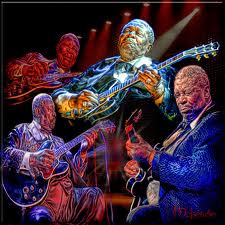
"I'm 85 years old, and I'm still singin' the blues." That's how B.B. King introduced his show at the Hult Center for the Performing Arts in Eugene on Tuesday, November 3.

Rebecca, Jory and I picked up some last minute tickets in the front row of the upper balcony section at the Silva Concert Hall.

I had considered going for awhile, but at the last minute, I thought I should take advantage of the opportunity to see B.B. King once again considering his age and his status as a longtime diabetic. I've seen him maybe a half dozen times over the years: the first time was at Springer's Ballroom in the hinterlands of southeast Portland in 1969.

It was a great show. His band, which included keyboard, drum, lead guitar, bass, baritone sax, tenor sax and flugelhorn, was tight. B.B. was good for about 90 minutes, then he signed off. I only hope I can do that well at his age.

Noting that he was 85, I realized he would have been 44 when I first saw him in concert as a 17-year-old blues neophyte. At left is a portrait of the artist as a young man. B.B. was named #3 on Rolling Stone's list of the 100 greatest guitarists of all time.

Wednesday, October 27, 2010

Capitol Hill Conundrum

As if I hadn't had enough, I was back in the "friendly skies" enroute to Washington, D.C. within three weeks of returning from Italy for the annual Public Relations Society of America (PRSA) International Conference held at the Washington Hilton (above) October 15-19.

PRSA, the world's foremost organization of public relations and communications professionals, has more than 31,000 members ranging from every practice area within the PR field, representing business and industry, agencies and counseling firms, government, associations, hospitals, schools, non-profit organizations and more.

Per usual, my role was to wear many hats: PRSA Assembly delegate representing both the Greater Oregon Chapter PRSA and North Pacific District PRSA (as an alternate for district chair Nancy Kincaid, who was unable to attend), and as professional advisor for the University of Oregon Chapter of the Public Relations Student Society of America. The PRSSA holds its annual conference in conjunction with PRSA.

Assembly is an interesting experience; it's the governing body of PRSA, with nearly 300 delegates representing 110 chapters in 10 districts, as well as 16 special interest sections. Assembly is always a lively affair, lots of people with lots of opinions, much like the nominating convention scene in The Man Who Shot Liberty Valance.

This year's point of contention was an amendment that would open up national board service to non-accredited members. The "Accreditation in Public Relations" (APR) is a credential -- achieved through a rigorous testing and interview process -- that acknowledges that a PR practitioner has the requisite knowledge for principled PR expertise and proficiency. This is important in a profession where licensure is not required and many people practice PR without knowing key competencies and appropriate ethical guidelines for decision-making.

After months of spirited debate on a PRSA e-group, followed by more passionate perspective at the Assembly, the amendment to remove the APR as a prerequisite for national board service was soundly defeated. Otherwise, my time was spent in meetings and sessions, though I had several opportunities to connect with the contingent of UO PRSSA student members in D.C. for the international conference.

With what little time I had left, I explored the Capitol Mall, including the White House (below), the Washington Monument, the Reflecting Pool and other points of interest in "our nation's capitol," as Forrest Gump might say. Despite my brief stay, I became quite proficient at using the "Metro," the subway system in Washington, D.C.

At the White House, I encountered a large contingent of police officers and secret service agents, none of whom looked too friendly. Ironically, President Obama was campaigning in Oregon.

He must have known I was gonna be in the neighborhood.

Tuesday, October 26, 2010

Return To Owl Farm

Like the Chinook salmon returning to the headwaters of its youth, Rebecca and I ventured up to the genesis of our relationship, the Lake Wenatchee-Plain area in North Central Washington, on October 6-10.

Specifically, our stated mission was to spend time in the wild with Carmen, our golden retriever, enjoy the fall colors (below, at the base of our property at the junction of the Chiwawa and Wenatchee Rivers) in the mountains and prepare Owl Farm for the winter snows.

Rebecca and I first met in June, 1978 at a week-long U.S. Forest Service fire prevention training session held on the Central Washington University campus in Ellensburg, Washington. The training focused on providing background on law enforcement, fire prevention education and natural history for seasonal USFS employees who were in positions that dealt with the public.

That season, Rebecca was a fire lookout (below) on Little Bald Mountain on the Naches Ranger District and I was a wilderness ranger on the Lake Wenatchee Ranger District, both on the Wenatchee National Forest. When she wasn't on the lookout, which had a spectacular view of the east face of Mt. Rainier, Becky lived with her brother Doug and family in Yakima.

Back then, I lived near the Lake Wenatchee Ranger Station in a rental dubbed the "Mushroom Haus" because of the "Alice in Wonderland-like" mushrooms painted on the side of the structure, located across from the historic Cougar Inn on Lake Wenatchee.

Having just returned to North Central Washington from reporting jobs at the Brookings-Harbor Pilot and The Canby Herald, both small weekly newspapers in Oregon, I was looking forward to a summer of hiking and climbing in the backcountry of the Glacier Peak Wilderness and Alpine Lakes Wilderness.

After Ellensburg, we traded road trips on weekends to see each other during the summer, making the drive between Yakima and Lake Wenatchee.

For most of the summer, however, Rebecca was on the lookout and I was patrolling the spectacular Chiwawa and Napeequa River valleys. Here, I was inspecting a hunter's cabin in the upper Buck Creek drainage.

When Becky was laid off from her seasonal lookout gig on the Naches Ranger District, she packed her bags and moved to Lake Wenatchee, joining me at the Mushroom Haus.

Shortly after her arrival, the two of us (along with "Pancake," a mule, and "Jimmy," a burro) went for a week-long trip along the Pacific Crest Trail (right) to collect garbage left over from the "high hunt" and make one last sweep through the backcountry.

On this, our last trip to Shugart Flats for the year, the memories were so thick, you had to brush them away from your face, to paraphrase James Earl Jones in Field of Dreams. Our long weekend was fabulous, spending time with Carmen, who has a keen interest in squirrels, and enjoying "another fine day in the flat."

The summer of 2010 will go into the books as a most enjoyable one, spending time in the backcountry with trips to Lake Minotaur and Lake Theseus (solo), to Lake Valhalla (with Frank Czubiak) and along Icicle Ridge (with Kelly Tjaden).

Kelly spent a considerable amount of time constructing Das Tree Haus (below, with Kelly's young friend from Snoqualmie Pass helping secure the ladder) at Owl Farm: Phase One is 90 percent complete.

Looking forward to more backcountry heaven in 2011.


Monday, October 25, 2010

Viva l'Italia, 9/7-9/24: Denouement

Much to the relief of some, we're coming to the end of this series of blog posts on mio viaggio attraverso d'Italia (my journey through Italy), so I thought I'd wrap up with a few observations on my wondrous and enlightening 17 days in the land of my forebears.

Some learnings: going to Italy solo is a good news/bad news proposition. The good news is that you can go where you want -- when you want. The bad news is that you're on your own, and there's a steep learning curve. I'll be much more efficient the next time.

Walking around the streets of Old Genoa, I thought the most noteworthy aspect is that people there love their dogs, and many take them everywhere they go. Canines of all varieties of breeds escorted young and old Italians alike.

Oddly, it seems like virtually everybody in Italy smokes, yet the life expectancy of an Italian is two years longer that an American (79 versus 77, respectively). Go figure. Their longevity must be attributable to diet and exercise.

At one of my breakfast sessions on the terrace, I met a nice French couple that was interested in my experience of the boat ride to Cinque Terre. When they found out that I taught college journalism, the woman said: "Oh, you must be a liberal." I thought: "What? Do I have a reader board on my forehead?"

Of course, the term "liberal" has a sometwhat different connotation as it related to politics in Europe, but she knew what she meant: one of those "doughy-handed, bleeding-heart liberals from that festering sinkhole of socialism that is Eugene."

It's funny. Some Italians looked like they wanted to kill me at times, or at least rough me up a bit; others wanted to practice their English and learn new stuff, saying they loved my West Coast U.S. accent.

I also like how Italians say "pronto" when they answer their telephones. It's like, "hurry up and talk or I'm hanging up."

Many have asked about the "bottom line" when it comes to a trip like this. The total cost of my trip to Italy? Just under $3,000.

Roundtrip airfare to Italy was $950, hotel expenses totaled about $1,000 for three- and four-star hotels. The cost of incidentals -- including dinners, train tickets, taxicabs, souvenirs, boat ride to Cinque Terre and other miscellaneous expenses -- was about $1,000.

The memories that will last a lifetime? Priceless. As I bade farewell to my hosts at the Hotel Cristoforo Colombo, I told them -- with my best Arnold Schwarzenegger accent -- "I'll be back."

Saturday, October 23, 2010

Getting Around: Planes, Trains and Automobiles

Transportation to, into, around, throughout and back from Italy was the adventure of a lifetime, to say the least.

My first stop in Europe was the Frankfurt International Airport in Germany (above). Moving through security and customs was a breeze, very organized and expeditious. They didn't even make me take off my shoes. Milano Malpensa Airport (below), on the other hand, was confusing and unnerving. Virtually nobody spoke English, so I was left to my devices -- and my Italian phrasebook.

Few things are worse than being lost, having to pee badly and unable to communicate. Like John Candy's character says in Planes, Trains and Automobiles, I would have had "more luck playing pickup sticks with my butt cheeks" than find a restroom in the Milano Malpensa Airport. Eventually, I found one -- before I peed my pants -- and when I did, it cost me half a euro to get inside.

After waiting for over an hour at a bus stop outside the Milan airport for transport to Genoa, a kindly taxi driver informed me that the last bus to Genoa had already left for the day.

He sent me to a money exchange inside the terminal, where a woman with a rudimentary grasp of English pointed me toward a motorcoach bound for the Milano Centrale train station (left).

Once I was on the bus, I felt a little less tense. But arriving at the train station, I was again confused -- and having to pee yet again (it was a 90-minute ride from the airport to the train station) -- while looking for the ticket office for a seat to Genoa.

At this point, it was late: 9 p.m. local time. I had already been traveling for 24 hours. Once I had a ticket in hand, I had five minutes to find my train, which fortunately I did. Catching the last train of the day from Milan to Genoa, I pulled into the city at about midnight.

Late as it was, a couple of taxi cabs were waiting outside the station. Hailing one, the driver had me at the front door of my hotel in less than 10 minutes. Cabs in Italy were quick and expeditious, if somewhat expensive (a ten minute ride was one euro per minute).

In Genoa, I paid 15 euros for the privilege of riding a tour bus, which traveled a route I had already walked. Walking virtually everywhere, both in Old Genoa and around other parts of the city, I learned quickly to keep a wary eye out for the innumerable motorini (motorcycles and scooters, above and below, right) at intersections. Traffic in Genoa was -- there's probably no other way to describe it -- organized chaos.

I can see why Italians drive little cars, motorcycles and scooters.

Aside from the parking issues and the price of petroleum, it's easier to maneuver the narrow streets of Old Genoa.

Nonetheless, people in Italy drive about one inch out of control, yet they somehow manage to avoid hitting anybody from the very large community of senior citizens who are out and about.
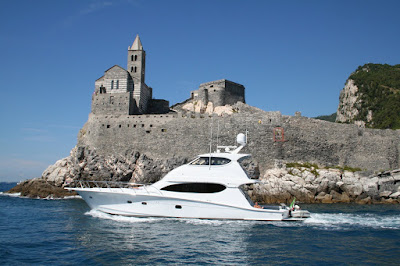
The boat ride to Cinque Terre (above) was a good way to see the sights of the ancient settlements along the Italian Riviera. Lots of expensive yachts were on display that day, particularly in Portofino.

My Dutch friend, a retired British Petroleum executive who owns his own boat, noted that the pleasure craft start "at about one million euros." In addition to recreational boaters, large cruise ships (below) and transports to points south (such as Sicily) were in evidence.

Toward the end, I was starting to feel comfortable taking the train to the extent that I could read and understand the schedules and protocols. Coming back from Torino, a young Italian dude joined me in my berth, but he didn't stay long.

After a heated exchange with the conductor, he got the boot for no train ticket (apparently, this is common in Italy, and some get away with it). Two mean lookin' train cops "put the arm on him" as I stuck my nose deeper into my book and slunk lower in my seat.

By the time I returned to Milan for my flight home, I was quite proficient at traveling by train. It's definitely the way to go in Italy, as it is in many other parts of Europe.
Friday, October 22, 2010

Things: Miscellaneous Musings

Let's start with the important stuff first: food and beverages. As you can imagine, the quality of food in Italy is what you might expect: "eccelente!" Even if you've been inclined to eating Italian cuisine your whole life -- like me -- you would have been impressed.

For breakfast, I ate on the terrace of the Hotel Cristoforo Colombo (above); the morning meal was included as part of the cost of my room. But this was no continental breakfast. It included an eye-opener of espresso, Cappuccino or Cafe Americano -- as many as I desired -- followed by several types of fruit juices. For protein, I had my choice of ham or salami and hard-boiled eggs. Topping it off was a selection of croissants, breads of all varieties and fruit cocktail.


For dinner, it was a different "ristorante" every night, and I always left as full as an egg; scores of restaurants dotted the narrow alleys of Old Genoa and all were quite different in terms of bill of fare.

However, the common ingredient was pesto Genovese, the famous sauce comprised of basil, garlic, Parmesan cheese and pine nuts. One night, I had pesto pasta cut into parallelograms; even with no meat, it was lip-smacking good.

Being so close to a major seaport (above), I enjoyed seafood pasta about every other night. As I noted in a previous post (http://gonzopublicrelations.blogspot.com/2010/10/italian-riviera-and-cinque-terre.html), the pizza in Genoa was spare compared to the sumptuous toppings found on an American pie.

The Italians excel at wine -- no surprise here -- and all the eateries were well stocked.

However, Italian beer was inferior for my taste. My brother Robert said that Italian beer "tastes like blood," meaning that you can't really taste it. I thought that Italian beer was a lot like Mexican beer (or Korean beer, for that matter). Think: Budweiser. As a result, I stuck with the German and Danish labels, including Ceres Strong Ale (left).

Throughout Italy, the art and architecture are a sight to behold. Celebrated architect Galeazzo Allessi (1512-1572) designed many of the breathtaking buildings in Genoa.

In recent years, the Italian government has emphasized a greater public awareness of the importance of contemporary architecture and urban design in the role of regeneration and redevelopment of cities, and Genoa is no exception.

Italians understand that the quality of their surroundings can lift the quality of their lives.

Beautiful frescoes grace the exposed sides of some of the buildings, while ubiquitous statues and sculptures honor the Good Shepherd (Jesus Christ, left) and leaders like Victor Emmanuel II, the "Father of the Fatherland."

Only one word can describe the buildings of Genoa: monumental.

Churches are also in abundance in Old Genoa. The Cathedral Di San Lorenzo (right), with its black-and-white marble facade, was only steps from my hotel. In fact, the bell tower was a consistent reminder of the time of day. The bell rings at 8 a.m., 12 noon and 7 p.m.

This tradition, from the old Italian "book of hours," was basically a call to prayers. The 7 p.m. bell signaled evening vespers.

The church bells were an extremely accurate barometer of time: the 8 a.m. bell was my final wake-up call. In other words, if I didn't have my rear out of bed by then, it was time.

It's a good thing the church bells were accurate because the clocks were not, as witnessed in the photo below. Naturally the hours will vary among the international cities featured here, but the minutes? This is a clock shop, mind you. For me, these clocks epitomized Italy in a way: sometimes stuff works, and sometimes it doesn't.

In terms of apparel, the Italians were -- by and large -- a well-dressed lot. Along with soccer, shopping is one of their favorite sports. But their focal point was "scarpe:" these people love their shoes. A small shoe shop betweeen my hotel and the Cafe Barbarossa was a popular establishment, always packed with people looking for new footwear.

Finally, a last word on toilets. When I first laid eyes on the bathroom in my hotel room, I thought: " what's the deal with the hot- and cold-running toilets?"

My brother Robert explained by text message that these are called "bidits," which are designed for washing one's private parts. In both of my hotels -- in Genoa (above) and Milan (below), the bathrooms also featured a second toilet, a water closet for "number two."

Well, we've been from one end to the other, so enough of this potty talk. I thought it would be a good way to "end" this blog post.

Thursday, October 21, 2010

Places: Somewhere In Time

Genoa -- and particularly Old Genoa -- was a fun and exciting place to hang out. The city's medieval section, complete with street vendors and seemingly a festival every day (and night), was fascinating.

Other than when I was out and about, the bulk of my time was spent in my hotel room, at the nearby Cafe Barbarossa and on the terrace at the top of the Hotel Cristoforo Colombo.

Let's start with my room. It was just as I expected it to be: tall ceiling with long purple curtains, wallpaper with patterns in olive and beige, old cherry armoire and dresser, full length mirrors -- just like my great-uncle's house in the Westmoreland neighborhood of Portland.

My room faced a narrow alley across from a residential building where I could hear the neighbors talking at times (right).

One night, I awoke suddenly to the sounds of two women boisterously engaging in "chiachere" or chit-chat. Their voices so closely resembled my Gramma and great-aunt, I swear I had been transported to the late 1950s, listening to them cackle while I dozed to sleep in the "cold bedroom" at my grandmother's house.

My brother Robert believes my flashback was the result of their dialect and accent; I agree, but it was also their voice quality, both in terms of tonality and cadence. Eerily similar.

Beginning with my first night in Old Genoa, I spent most days during the cocktail hour at the Cafe Barbarossa -- conveniently located next door to my hotel -- where they served generous portions of "antipasti" (i.e. appetizers, including focaccia bread, ham sandwiches, potato chips, celery, carrots and green olives).

A life-size Elvis Presley greets guests at the door of the Cafe Barbarossa (left).

Breakfast was served daily on the terrace on the roof of my hotel. Open for guests from 6 a.m. until midnight, the terrace featured nice views of the Port of Genoa and the city (below).

In the daytime, I could spend quality time reading and writing; in the evenings, I had the whole terrace to myself, sucking on bottles of Ceres Strong Ale and texting my network of family and friends.

Simply put, Cinque Terre (below) did not disappoint. The ability to view these ancient villages by boat was fantastic. The villages cling to mountains choked with olive groves and dry-stone-walled vineyards, where farmers have eked out a living over many centuries.

Wine growers still use a monorail mechanisms to ferry themselves up and the grapes down these uniques lands. In some cases, farmers must harvest their crops by boat. If the hillsides are not worked, they will quite literally slide into the sea.

Torino was quite different from Genoa. Where the streets are windy and curved in the hometown of Columbus, the avenues in Torino (below) are straight and laid out in a grid format. You can tell the city has been influenced by the Swiss and others from points north.

Milan is simply a big city. An industrial center in Northern Italy, Milano is filled with many classic buildings, sculptures and other art. I spent my last night in a Milan airport hotel that was nice, but spendy: 150 euros for one night (by comparison, I spent only 900 euros for 19 nights at the Cristoforo Colombo Hotel).

My clear favorite of these three of the ten largest cities in Italy was -- no surprise here -- Genoa. The main shopping streets and squares descend into the city's medieval old town. Nearby, Genoa's historic port and newer dockside areas are crowded with cruise liners, fishing boats, ferries and yachts, as well as a world-class aquarium.

Exploring this ancient maritime city gave me an insight into Italy's past and present that was unique. For me, Genoa turned out to be so much more than a place; it was a trip through time.