Monday, August 22, 2011

Chiwawa Basin, Day 1: Trinity Mine

The trail to the basin below Chiwawa Mountain (above) begins at the old mining development of Trinity, situated deep in the North Cascades. So on Saturday, August 20, Steve and I drove the 25-mile Chiwawa River Road to its end at Trinity.

Now a virtual ghost town, Trinity once was home for over 300 men and women employed by the Royal Development Company of New York in its heyday -- the 1920s and 1930s. In those days, the residents of Trinity had high hopes of "striking it rich."

Today, however, Trinity has been reclaimed for the most part by Mother Nature, who dumps an average of 14 feet of snow on the town site annually.

Destroyed by fire or crushed by the weight of many years of snow, most of the original 38 buildings are now gone. What remains are a few residences (left) and the generator plant.

Beginning in the 1890s, a number of companies -- including the Chelan Mining Company -- established claims in the area for silver and gold. Most failed to find anything of value and ceased operation. Then, in 1918, F.J. Naughten, a stockholder in the Chelan Mining Company and a Roman Catholic priest, hired mining engineer P.J. Lonergan, who determined that there was little silver or gold at the site but significant amounts of copper.

Father Naughten then recruited his brother James, a miner from Montana and, together with Lonergan, formed the Royal Development Company. Mining operations commenced immediately, but heavy snowfall and avalanches in the narrow Phelps Creek valley forced them to abandon work in the winter.

The solution was to blast a 11,000-foot tunnel into the side of Phelps Ridge (below) which would provide year-round access to the ore. The Royal Development Company sold stock to fund the mine. A hydroelectric project, first on nearby James Creek and later on the larger Phelps Creek, would provide power to the town and the mine.

But in 1938, the mine closed permanently for economic reasons; apparently, the ore was not of sufficiently high grade to continue mining. However, several old-timers associated with Trinity had other perspectives, which they shared with me for a magazine article I wrote for a Seattle-based recreational journal back in 1982.

Mildred Naughten, wife of James and proprietor of Parkside Grocery at Lake Wenatchee in the 1970s, said she and her husband were excited about the prospect of mining vast deposits of copper, gold and silver. But W.O. (Bill) Burgess, another old-timer, noted that the mine was built "totally on speculation." In other words, the investors were protected but the miners were not.

But hopes were high, based on continued investment by the Royal Development Company. This optimism was accentuated by the fact that the Roman Catholic Church had, in part, financed the mine. Naughten said the town site was booming despite the Great Depression, and many new buildings were constructed, including a mess hall, sawmill and residences, with more in the planning stages.

Then, one fateful autumn evening in 1931, the news came across the wire from New York City: the Royal Development Company had ordered the mine closed. They gave no explanation for the closure.

Naughten explained that many of the miners -- immigrants from Eastern Europe -- had recently come to work at Trinity. They had spent what little money they had stocking up on groceries and goods for a snowbound winter of anticipated work. Suddenly, they were out of a job and they were mad -- real mad.

"That night, they started drinking," Naughten reminisced, noting that the group of immigrants soon became a howling mob, violently angry because the main office had closed the mine for what the miners perceived as a "phony financial reason" rather than a lack of ore. She said they "went on a rampage," breaking windows and otherwise destroying company property.

"All of them had their wine, and they became unruly," said John Hendrickson, another old-timer who worked at the mine. "Liquor was a precious commodity in this remote community." One winter, he remembered, a man attempting to bring in a case of whiskey got lost in the deep snows and died in the woods leading to Trinity. "They didn't find his body until the following spring," he noted.

"This really was a struggle between those who were operating the mine and those who were financing the mine," said Naughten. The financiers -- all Easterners -- could care less about the mine, she said. All they wanted was to get hold of the money set aside for investment in the mine. The angry miners sensed this undercurrent, so they took their frustrations out on the company.

"I guess they took their vengeance out by smashing buildings," recounted Naughten. "It was really frightening. You just don't know how far a mob will go under the circumstances. It was sickening news for people to suddenly have the work stopped."

Naughten said the situation was intensified by the belief that the miners were betrayed by one of their own. "There was someone in the office who, the miners felt, was getting information back east as to when the shipment of ore was going to the smelter (in Tacoma)," said Naughten. "The men suspected who it was, but the nearest it came to any trouble was talk about tar and feathering the guy."

No serious attempt has been made at mining the Trinity tunnel since, and the buildings that remain are grim reminders of the aborted investment of the Royal Development Company. The Trinity town site, which sits in the shadow of 8,500-foot Buck Mountain and other spectacular peaks at the headwaters of the Chiwawa River, has gone through several owners since 1931, all content to enjoy the property as a recreational retreat.

As Steve and I hiked through the town site on our way to Chiwawa Basin, I reminisced about these old-timers and their stories of days of hope and human stamina, corruption and collapse, and finally, despair and drunkenness. After hiking the five miles into the basin, we stopped for the evening at a campsite at the junction of the Chiwawa and Red Mountain trails (below).

Tuesday, August 9, 2011

The Rabid And The Reactionary

Editor's note: Here's my latest response to some of the obtuse opinions on the editorial page of The Leavenworth Echo. We'll see if Publisher Bill Forhan, who owns a number of weekly publications in North Central Washington, runs it. He didn't print my last letter, even though he has a standing policy of printing all letters.

In response to "Liberal Drivel Must End" in the 7/27/11 edition of The Leavenworth Echo, the irony will be clearly evident to readers that Bill Cowles needs to take a look in the mirror.

The word "drivel" is defined as "saliva flowing from the mouth, or mucus from the nose" or, in a secondary context, "childish, silly or meaningless talk, nonsense or twaddle." Cowles accomplishes both with his letter to the editor.

In the first instance, Cowles illustrates in no uncertain terms that he is foaming at the mouth. His continued attacks on other so-called "liberal" letter writers shows a mean-spirited attempt to dinimish their perspectives while offering few original thoughts of his own. What little substance he offers is unattributed.

In terms of the second definition, his grammar and style are atrocious. Case in point is the line: "I realize the deserved negative tone of this letter because I am sick to death of reading the false and asinine attacks of the liberals on us conservatives." Huh?

Publisher, continuing to print such nonsense is doing nothing to enhance the credibility of The Leavenworth Echo's editorial page. Like the Leavenworth City Council, perhaps The Leavenworth Echo should consider a noise ordinance of its own.

Editor's postscript: Well, it took him about a month, but Publisher Bill Forhan did publish my letter, along with the following comment.

"Thanks for that opinion, John. I would say that free speech doesn't guarantee freedom from exposure to the thoughts of those we feel are less enlightened than we are. I can guarantee I see plenty of noise on both sides of the argument."

My comment to his comment? "Yes, Bill, it's true that even a neanderthal like Bill Cowles can have an opinion, but do we have to hear about it every week in The Echo? You're not that hard up for letters, are you?"

Sunday, July 31, 2011

Sequestered In Chicago

For the second year in a row, I served on the national nominating committee for the Public Relations Society of America, which meets every summer to select candidates for PRSA leadership in the Hilton Hotel adjacent to Chicago's O'Hare Airport.

But this little hootenanny is no junket, I assure you. The group of about two dozen or so committee members from around the United States is virtually sequestered -- like in 12 Angry Men -- in the hotel.

Following the four-hour flight from Eugene to Seattle to Chi-Town on Friday, July 29, committee members gathered for a business dinner from 6-10 p.m.

The next morning began at 7 a.m. with breakfast, followed by about 12 hours of interviews with prospective candidates for national leadership, both live and by telephone. Whew!

But there would be no rest for the wicked. On Sunday, we once again began early for more deliberation and discussion, wrapping up in the afternoon just in time for my flight back to Eugene.

Needless to say, there would be no trip to a Cubs game for this kid.


Wednesday, July 27, 2011

Marvelous Munich, 6/13-7/2: Denouement

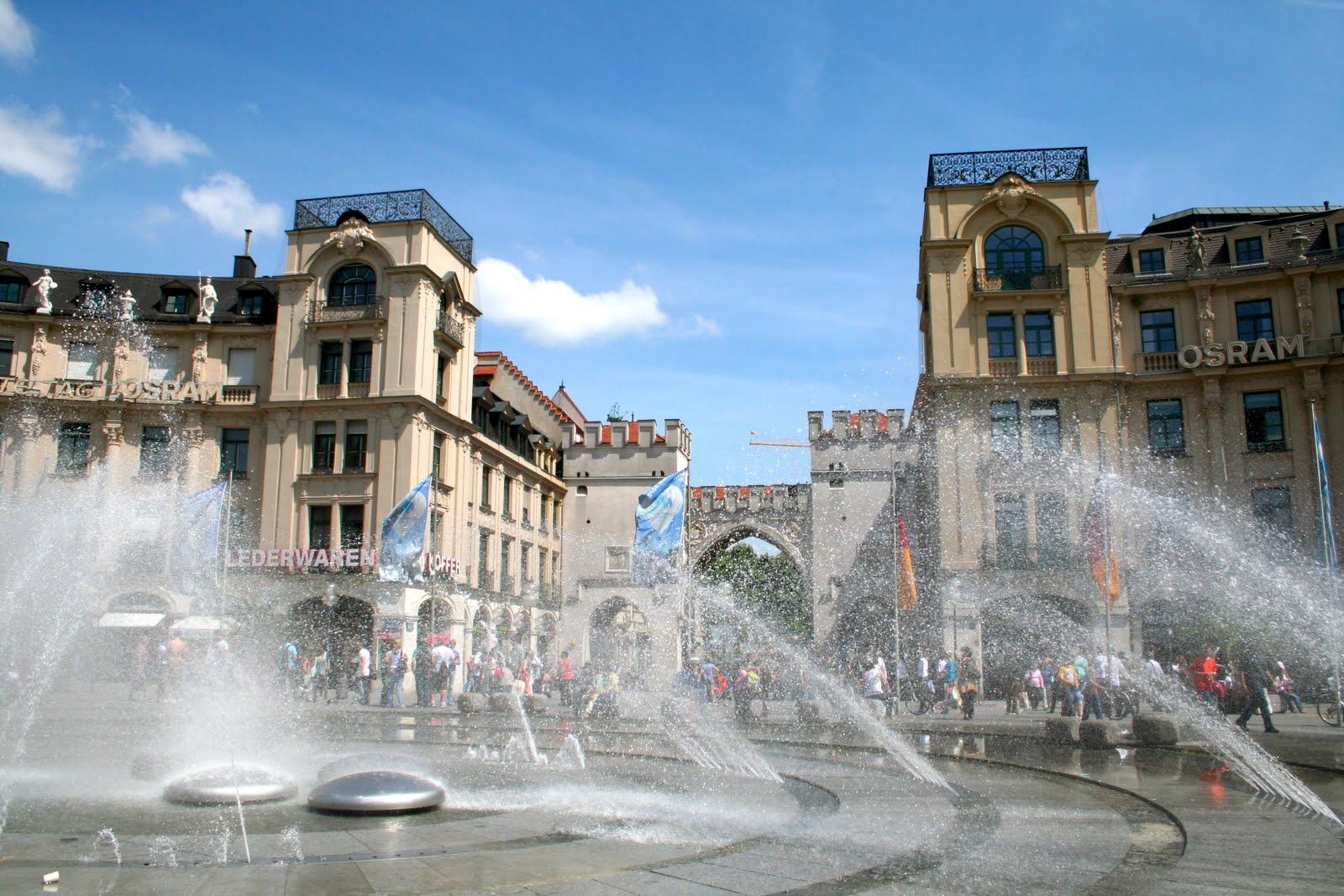
Munich was pretty much as I had envisioned: a fun, vibrant metropolis featuring a lively city center with much to see and do.

The flight from Portland to Amsterdam was my first transcontinental journey where night never fell, primarily because we flew over Canada, Greenland and Iceland, the "land of midnight sun" during the week of the summer solstice in the Northern Hemisphere.

The Altstadt, where my hotel -- the Hotel Deutsches Theatre -- was located, is an eclectic neighborhood known as Ludwigvortadt, a half-seedy, half-lively area packed with shops, restaurants, hotels and plenty of tourists.

Bavaria has traffic signals, of course, just like everywhere else, but with one key distinction. Instead of signaling a stop, the yellow light alerts motorists that it's time to go. In other words, the amber signals a green light instead of a red light.

This photo metaphor for Munich (left) was apropos: an old stump with a young seedling sprouting from its top in a busy boulevard north of the Kalsplatz in Altstadt.

Venturing to the rural areas on our way to the Alps, it's clear why Germany has such high quality milk and cheese: cows everywhere. Another prevalent feature of rural Deutschland is all the renewable energy projects. One thing is for sure: in the U.S., we're a bunch of renewable energy lightweights when compared to Germany.

The photovoltaic arrays (not to mention wind turbines) are everywhere, even in the mountain country where solar access is perhaps not as good as in the lowlands around Hamburg. They would probably put solar arrays on cows if they could get the bovines to stand still in the sonnenscheine.

Lions -- like the ones above in the Neues Rathaus in the Altstadt -- are common icons around Bavaria because of Henry the Lion, who founded the city of Munich in 1156.

One of the most powerful German princes of the time at the height of his reign, Henry the Lion presided over the lucrative salt trade in Bavaria, and ruled over a vast territory stretching from the North and Baltic Seas to the Alps.

As previously noted, the Altstadt includes a plethora of elaborate Roman Catholic churches. The Frauenkirchen choir section also features the final resting place (above) of Ludwig I, King of Bavaria.

Like the the tagline on the bag for the shirt that I purchased at Abendzeitung, the Hotel Deutsches Theater provided "mehr Munchen, mehr service and alles drin" (more Munich, more service, all included). And much like I found in Genoa, the people of Munich have a joie de vivre that is contagious.


Saturday, July 16, 2011

Getting Around: From Abenberg To Zugspitze

In Germany, you have a variety of ways to get from Point "A" to Point "Z," not to mention all points in between.

Arriving in Munich, the first thing I noticed was the clean and efficient airport. Unfortunately, the Munich airport turned out to be a full hour cab ride to my hotel in the Altstadt, a 70-euro cruise.

But taxis are only one of many ways to get round in Bavaria: trolleys (above), trains, buses and bicycles are all popular forms of transportation.

Bicycles are particularly ubiquitous (left). Many local residents use the manual two-wheelers to tool around the city.

However, unlike in the U.S., where bike paths are located on the street, Munich's bike routes are located above the curb, between the sidewalk and the street.

Pedestrians must cross the bike path to get to the sidewalk from the street, and bicyclists don't expect you to be walking in their designated lane. It can be dangerous for unsuspecting pedestrians.


Trolleys (above) are an inexpensive mode of transport, but they focus almost exclusively on the city center. The best way to get around is by using the train. The rail system in Munich includes a comprehensive network and trains are the mode of choice for most residents.

One day, Gina and I ventured to the suburbs of Munich by taxi, but took a bus, then a train back to the Altstadt. Very simple, very easy. And did I say affordable?

On our various tours of Bavaria, we rode Grey Line buses. This was my first real exposure to the autobahn, where Mercedes and BMWs would blow by our bus like we were standing still.

I was under the impression that the autobahn was a special, exclusive highway. I was misinformed. In reality, the autobahn is merely an interstate freeway, with the left lane reserved for speed freaks.

On our excursion to the Zugspitze, we climbed aboard a cable car (above) for the ten-minute trip. The ride, which sways from side to side, is not for the squeamish, or those who suffer from vertigo.

On our way down, we rode the cogwheel train, which descends through a tunnel before emerging a third of the way down the mountain to a spectacular view of Lake Eibsee.

Despite the cost, I arranged for a taxi ride to the airport on my way out, primarily because I had my baggage, plus Gina's big bag, to take back to America. The upside was that I received a primer on Hungarian history from my driver, a native of Budapest.

Thursday, July 7, 2011

Things: Odds 'N' Ends

The German people do a lot of things well, but they particularly excel in two areas: beer and cars. Naturally, a trip to a biergarten -- in my case the Hofbrauhaus (above and below), ground zero for the Oktoberfest -- and a cruise on the autobahn are usually at the top of many to-do lists for outlanders "on holiday."

German beer is arguably the best in the world -- and it's likely because of the fact that Deutschlanders have had so much practice over the years. In Germany, the science of brewing beer began with the Germanic tribes but was considerably refined by Benedictine monks who migrated to Bavaria across the Alps from Italy.

The secret of this beneficient brew is the reinheitsgebot, or purity law, which required that breweries use only four simple ingredients: malt, yeast, hops and water. Passed in 1516, the statute is no longer a legal requirement, although many brewers still conform to it anyway as a marketing ploy against the "big-boy" brewers.

In no small part thanks to the reinheitsgebot, German beer is unique in not producing the after-effect called a katzenjammer, or hangover. And despite just four ingredients, Deutschlanders nonetheless produce over 5,000 distinct varieties of beer, including bock, pilsner, lager, wheat and white, just to name a few of the general categories.

Established in 1397, the Spaten brewery is the oldest in Munich. The popular Paulaner (below) brewery, founded in the early 17th century by Minim friars, is also located in Munich. And, of course, over six million visitors annually join the over one million residents of Munich to pack the massive beer garden near the Altstadt for Oktoberfest.


Germany is also well-known worldwide for its finely engineered automobiles, particularly BMW, Mercedes Benz and Porsche, not to mention the more pedestrian but nonetheless serviceable Volkswagen and Audi.

BMW Headquarters (right) is actually located in Munich between Olympiapark and Englischer Garden. Shaped like eight cylinders on a deluxe model, BMW also has a very cool museum for visitors.

Mercedes Benz also has a presence in Munich (below), but the Mercedes museum is in nearby Stuttgart. I've owned a number of Volkswagens: good, reliable autos that could withstand the type of abuse I could administer to many a dubious vehicle in my youth.

I've only owned one Mercedes; it was a basic 1962 model. It wasn't much to look at -- painted a dreary battleship grey -- but it had a four-speed on the column and leather upholstery, a unique commodity back in those allegedly halcyon days of yore.

The food in Germany offered a mixed bag, about as different from Italian cuisine as another country can be. I've never been a big fan of sauerkraut because of my inherent revulsion to cabbage (in Korea, I didn't like kim chee either), but the local variety was definitely better than any I've had in the United States.

Loved the Wiener schnitzel, though, a breaded veal cutlet dipped in flour, egg and breadcrumbs, then fried in butter of oil to a golden brown. Breakfast at the Hotel Deutsches Theater offered great variety, with eggs, meats, fruits, cereals and breads galore, as well as some of the best milk and cheese I have ever tasted.

The architecture is as you would expect: stunning but strangely different. A German peculiarity -- using a rainbow approach featuring Byzantine and Roman buildings, along with gothic and baroque stylings -- provides a veritable grab bag of unique structures.

The spectacular 19th-century architecture in Munich, as well as many monuments, have been painstakingly rebuilt following mass destruction from bombing raids by Allied pilots during WW II.

Brigit, one of our tour guides, noted that some of the less magnificent buildings -- particularly residential highrise structures -- were built rather hastily after WWII to provide homes for displaced citizens.

The art, such as the satyr sculpture (right) at the Linderhof castle, the primary residence of Ludwig II, is also classic Western European. Frescoes, paintings, sculptures and other art forms are omnipresent throughout Bavaria.

The German flag (below), which is rather unique among the many flags of the world, originated during the freedom wars against Napolean in the early 19th century, with volunteers (mostly students) arriving from all over Germany to fight the French Emporer.

In order to provide the rag-tag group with a uniform appearance, these volunteers colored their clothes black, complimented by brass buttons and red trim: hence, the easily-identifiable red, black and yellow bars of the German flag.

Finally, despite all the stern looks and humorless expressions -- and contrary to popular belief -- Germans do have a light side, as witnessed by the lifelike models perched on the ledge above a Marienplatz storefront advertising "Oktoberfest costumes and more."

Wednesday, July 6, 2011

Places: Around The Bavarian Horn

Aside from a brief stop in Amsterdam and a couple of loops into Austria, we spent most of our time in Germany. Can't imagine trying to see the whole country (or any European country, for that matter) in only three weeks, but we had a good taste of Bavaria.

I've spent plenty of time covering Munich, so I'll just say this: for a city of 1.3 million people, it's fairly compact and probably smaller in terms of area than Portland, Oregon. The Bavarian capital has plenty of green space and the River Isar flows right through the middle of town. The Altstadt (Old Town) is truly vibrant and easy to get around, with many favorable comparisons to one of my favorite European towns, Genoa, Italy.

The suburbs are very nice; Gina and I took a cab to the perimeter of the city and jumped on the train for the trip back. But the city's major sites are grouped around Marienplatz in Old Town, just blocks from our hideout and place of repose, the Hotel Deutsches Theater.

The soot-black, and major gothic, Neus Rathaus features statues and gargoyles (above, right) -- and, of course, the town's glockenspiel.

The Viktualienmarkt, one of Europe's premier food (and people-watching) bazaars, converts into one of the finest and most expensive beer gardens around, sometimes earlier in the day than later.

Just north of the Marienplatz is the Englischer Garten (where Gina would get in her runs), the town's principal park, a major aboretum which is much larger than Central Park in New York City.

On the trip to two of the royal castles built by Ludwig II -- Linderhof and Neuschwanstein -- we explored Oberammergau and Fussen, two little villages tucked away in Germany's Bavarian Alps.

Oberammergau (above) seems to be more rural and something less of a tourist trap than Fussen because of the sheer numbers of people visiting the "Disneyland" castle in June.

We rolled through Berchtesgaden and Obersalzberg, two lovely Alpine skiing villages on the Austrian border that -- unfortunately -- will be forever associated with the life and times of Adolf Hitler (above).

Prior to the Zugspitze, it was the little town of Ettal (below), along with the larger Garmish and Partenkirchen. All had features reminiscent of the American version in Leavenworth, Washington.