Tuesday, November 29, 2011

Standing With The Hat

The big news around these parts is that University of Oregon President Richard Lariviere has been fired "without cause" by the state Board of Higher Education and -- for all intents and purposes -- Governor John Kitzhaber in a major showing of no confidence.

The day after Thanksgiving, with nary an attempt at transparency, the board scheduled a meeting on Monday, November 28 to discuss the apparently predetermined "finis" of the popular Lariviere. The tactic was an ingenuous ruse at best, and a public relations disaster for state government at worst. Campus was closed on Friday and most associated with UO were enjoying the four-day weekend.

When news surfaced about the Monday meeting in Portland, the antennae of conspiracy immediately sprouted on the UO campus. My UO email in-box overflowed with outraged yet well-reasoned prose opposing his termination by members of the greater UO community.

Calls to retain the UO president and disband the board reverberated around the campus. Saddled with a barrage of digital communication, it was hard for me to discern the desperate pleas of mercy from students seeking an extended deadline on an assignment.

Shocked like many others in the UO community, it wasn't a question of whether I had a dog in this fight, but how many.

As a UO alum, I've observed with heightened concern over the diminishing state support for higher education over the past 30 years. The State of Oregon now provides less than 7 percent of the funding for the University of Oregon. It's hard to maintain "excellence" when the fiscal noose continues to tighten, squeezing the life out of my alma mater like a python strangling its prey.

Yet despite continued reductions in state support, the UO has survived and -- indeed -- thrived, thanks in part to Lariviere. Enrollment and fundraising are at an all-time high, and Lariviere has a vision and a talent for inspiring others on campus to strive for an even better University of Oregon.

As a longstanding part-time employee of the University of Oregon, I've seen talented faculty recruited by other, more well heeled universities because of below market compensation policies, particularly when compared to faculty at other public institutions. Quality of life only takes you so far. Lariviere knows this and recently awarded $5 million in pay raises to 1,300 UO faculty and staff.

As a consumer who has helped put his kids through UO, I've witnessed increasing tuition rates to help compensate for the loss of funding from the state. Backed into a corner, the UO has established a business model that utilizes out-of-state and international student tuition rates to balance the budget. In-state tuition is less but continues to rise faster than the consumer price index.

The University of Oregon currently receives less money from the state per capita than any other public university in Oregon.

It's not a pretty picture, and no matter how you slice it, the state has withdrawn its investment in higher education.

Lariviere's "New Partnership" initiative sought to address the shortfall and bring greater financial autonomy to the UO.

My personal experience with UO President Richard Lariviere is strictly anecdotal, though he has impressed me as someone I would want on my team. The first time I met the man was on my path to school one morning. Passing him on my way to Allen Hall, he tipped his ever-present fedora and smiled: "good morning." As a humble adjunct faculty member at the UO SOJC, I was immediately impressed.

My next encounter was the result of an impromptu photo shoot during the parade last January to honor the Ducks for their stellar football season. I shot a number of pix and posted them on Facebook; his wife, Jan Lariviere, spotted one of my images of her husband and asked to be my "friend" on the social networking site. Later, Richard himself would "friend" me (has "friend" become a verb?)

When Lariviere was informed that his contract would not be renewed, he sent all faculty, staff and students an email: "I received news on Monday in a meeting with the chair of the state Board of Higher Education that my contract at the University of Oregon will not be renewed. I was told that I could resigned or accept the termination of my contract (in July, 2012). I am weighing those options at this time."

Clearly, he had irked the board, an antiquated and ineffectual -- and in this case draconian -- body of volunteers, as well as Governor John Kitzhaber, for "not being a team player" and for pursuing his own agenda of a more independent University of Oregon.

Unfortunately for the board, its back-alley effort to terminate Lariviere over the Thanksgiving holiday weekend backfired. The local community and many others rallied behind Richard Lariviere with a grassroots "We Stand With The Hat" campaign in an attempt to force the board to retain the UO president.

A rally and teach-in was scheduled for Monday on campus, and support for the president was pervasive at the annual Civil War football game between Oregon and Oregon State at Autzen Stadium on Saturday, November 26. UO alum and Nike founder Phil Knight likened the board's impending action against Lariviere as a "bad decision" that seemed to resemble an "application of Oregon's assisted suicide law."

On Monday, a large contingent of UO faculty, alumni and students packed the room at Portland State University in a two-hour public meeting that can only be described as testy, volatile and emotionally wrought. "It was quite warm in that room, over 100 degrees," noted eyewitness Loren Ruark, a KVAL-TV cameraman and friend who observed the resulting fireworks. He may have been only mildly exaggerating about the temperature: "it was hot," he added.

The efforts of supporters would not be enough; the state Board of Higher Education fired Lariviere for "frayed relationships" and "broken trust." Response was instantaneous and harsh: board members were met with jeers and boos as they attempted to explain their positions.

If anything, the abrupt dismissal of Richard Lariviere has only fanned the flames of efforts to support the UO's quest to survive.

And, in a case of 20-20 hindsight that can only be described as a "make up call" in sports parlance, the board has appointed Lariviere's part time assistant Robert Berdahl -- a former University of Oregon professor and dean -- as interim president, a clear showing of deference to the greater UO community.

As for Lariviere, stay tuned. As a tenured professor in Sanskrit, we may continue to see "the hat" on campus for some time to come.

Thursday, November 3, 2011

Agate Hall

Starting to settle into the new environs in vintage Agate Hall (above), where the University of Oregon School of Journalism and Communication has moved on an interim basis while Allen Hall is expanded and remodeled. With a total of 47 students in two sections of public relations writing, I'm keeping plenty busy.

Most seem to agree: the new facility is both comfortable and spacious, a welcome respite from crowded Allen Hall. Agate Hall sits opposite Hayward Field and the new soccer fields (below), with recently retired McArthur Court in the background.

Designed in the California "mission style" using a stucco exterior on a rectangular floor plan, Agate Hall was contructed in 1924 as Theodore Roosevelt Junior High School, making it eligible for the national historic register. The facility is eerily similar to the Catholic grade school I attended for eight years in Portland, down to the antiquated urinals in the restroom.

Agate Hall became Condon Elementary School in 1950, and eventually housed the first Magnet Arts Alternative School. The Eugene School District closed the school in 1983 due to low enrollment. The UO acquired the property in 1984 and named it Agate Hall.

The chimney on Agate Hall is decommissioned but has become a local curiosity because of the large number of Vaux's Swifts roosting inside the stack during their annual summer migration. When the swifts vacate the chimney in September, it's a sight that rivals the bats abandoning the Congress Avenue Bridge at sunset in Austin, Texas.

Since I walk virtually everywhere these days, I have a new route to class. Allen Hall resides in the northwest corner -- while Agate Hall is located in the southeast corner -- of the UO campus.

So instead of the Jordan Schnitzer Museum of Art, I now skirt the music school where I enjoy the melodic strains of the woodwinds and keyboards, and the Pioneer Cemetery, a virtual arboretum in the middle of campus.

Students (above, hard at work) and staff alike seem to be acclimating quite nicely to the new j-school digs in Agate Hall. I also love how the writing labs provide for an open forum for teaching. Plus, we have our own auditorium complete with a second story balcony.

Now, if I can just get over that foreboding sense that -- at any moment -- Mother Superior will burst into the restroom, barking at us to return to our seats....

Sunday, October 23, 2011

Dues Dilemma

Made my annual sojourn to the Public Relations Society of America (PRSA) Leadership Assembly, this year in Orlando, Florida on October 14-18. That exercise in governance was followed by the PRSA/PRSSA International Conference, both held at the J.W. Marriott at Grande Lakes (above), a chic facility and convention center adjacent to the Ritz-Carlton near the headwaters of the Everglades.

The "elephant in the living room" at Leadership Assembly was a hotly-debated dues increase for members, always a tough proposition but particularly gnarly in a down economy when small chapters struggle to maintain membership. Sentiment among smaller chapters favored a "no" vote in discussions on North Pacific District conference calls, while larger chapters favored the increase, the first in 10 years.

Despite the apparent split, the proposal passed by a nearly 4-1 margin (209-53) and will raise annual PRSA dues by $30 in 2012. Most delegates appeared to understand the rationale for a dues increase, thanks to a lot of front-end work by the national board. Discussion of the proposal lasted a mere 10 minutes.

The only sideshow -- per usual -- was Jack O'Dwyer, purported journalist and self-appointed watchdog of PRSA. For the first time, Jack was refused a press pass to the PRSA Leadership Assembly and, needless to say, he was not happy. He nonetheless lingered nearby for the remainder of the conference, badgering leadership in the hotel bar at the J.W. Marriott at Grande Lakes.

The Leadership Assembly also expeditiously approved the slate of national PRSA officers and amazingly adjourned by 3 p.m. -- a new record for early conclusion in my six years as an assembly delegate representing both the Greater Oregon chapter and the North Pacific District of PRSA. Delegates could hardly contain their delight, gleefully scattering to the pool for a lawn chair and a Cuba Libre.

The next day, the PRSA/PRSSA International Conference began with a theme of Imagine, Create, Inspire. The opening ceremony featured Disney's Voices of Liberty (below), considered the finest a capella singing group in the world. As you might expect, Walt Disney World was a major sponsor of the conference.

Following the opening ceremonies, the conference featured two amazing keynoters: CNN anchor and special correspondent Soledad O'Brien and CEO of the X PRIZE Foundation, Peter Diamandis.

O'Brien, who has worked at CNN since 2003, reports breaking news from around the globe and has produced documentaries on many important stories affecting the world today in her In America series. She noted that, like journalists, public relations professionals need to be good storytellers for their client or company: "we both deal in stories. Humans have always been connected to stories. Storytelling is more than just a compelling fact or statistic."

Diamandis was also a dynamic speaker; I first learned of his X PRIZE Foundation when reading Paul Allen's memoir, Idea Man. An international leader in the development of the personal spaceflight industry, Diamandis founded the educational non-profit institute with a mission to affect radical breakthroughs for the benefit of humanity.

"True breakthrough ideas don't come out of large corporations or organizations with top-down structures," he noted, saying that it was smaller teams consisting of diverse and non-traditional individuals -- isolated from the whole -- who have found success. He cited Apple and IBM as examples.

"The 'expert' is the one to tell you why something cannot be done, not the one with the crazy idea," he says. "The fact is that it's the crazy idea that will lead to a breakthrough." In other words, he seemed to be saying: "Why not go out on a limb? Isn't that where the fruit is?"

For the remainder of the conference, I spent time in professional development seminars on the use of social media in public relations, research and measurement and the like, as well as hanging with my peeps from the University of Oregon chapter of the Public Relations Student Society of America (below).

Otherwise, I could be found sipping a Cuba Libre by the hotel pool.

Wednesday, September 28, 2011

Owl Song

Initiated an impromptu trip to Lake Wenatchee (above, with Dirty Face Peak in the background) with Rebecca -- and Carmen, our golden retriever -- on September 22-25. Had to button up Owl Farm for the winter and help friend Kelly Tjaden replace a beam on the foundation of the tree house he's building on our property.

Leaving Eugene on Thursday morning early, we gutted it out the full 400-plus miles to Plain, Washington in time for a barbeque salmon dinner on the property. Carmen loves frolicking in the woods and the rivers, so she would enjoy being in her element.

Kelly arrived on Friday and we spent some time rounding up a few more 2 by 12s to beef up the existing beam on the tree house (above), the south side of a triangular foundation. On Saturday, we spent time putting together a heftier beam that would be twice as large as the original in an effort to bolster the previously sagging span.

When completed, the renovated beam would measure 8 inches by 12 inches by 18 feet in length. The final product looked heavy, so we put in a call for reinforcements and neighbor Thomas Steinke gamely volunteered to help us hoist the unwieldy beam into its place on the tree house (view looking southwest, below).

Kelly, Rebecca and I (and Carmen, of course) celebrated the day's accomplishments with a bottle of wine, a movie on the laptop and a Duck football game on the satellite radio.

That night, I awoke just before sunrise to a duet between an owl and a rooster. The owl hooted in a desperate attempt to forestall the sun; meanwhile, the rooster countered by crowing the inevitable arrival of dawn. They seemed to be singing by turn, one in response to the other, quite the battle of the birds.

Wednesday, September 14, 2011

Old School, Part Deux

Well, the lads from the Jesuit High School Class of '71 finally got their collective act together at the eleventh hour in time for a 40-year high school reunion. Rumor has it that Jesuit administrators put the "Jersey squeeze" on one of our former classmates, Tom Manning (currently a teacher at Jesuit) to make some calls.

And so it was, on Friday, September 16, I ventured to Portland to join longtime buddy Tim Nashif in attending the second of two high school reunions this summer. This one was held at Ernesto's, an Italian restaurant immediately adjacent to Jesuit High School in Beaverton.

The agenda included a social and buffet dinner, followed by the "Holy War," the annual football fracas between the Jesuit Crusaders and their chief rival, the Central Catholic Rams.

Some say that your sense of smell can trigger more memories than any other of the five senses.

As we entered Ernesto's, the unmistakable aroma of Tuscan cuisine penetrated my nostrils and every other fibre of my being. But this establishment wasn't just any Italian restaurant; the scent was eerily familiar.

I couldn't put my finger on it, until a little later in the evening.

After checking in at the registration table, we chatted with old classmates while watching the first half of the football game out the window at Ernesto's, which beamed directly down onto Jesuit's Cronin Field. No fooling, it was kind of like being in a skybox.

We adjourned to the field in the second half, where the Crusaders blocked a field goal attempt by the Rams in the final seconds, escaping with the win in a 14-12 nailbiter.

Later, we met the owner of Ernesto's -- Mike Ceccanti. I explained my nasal nostalgia and he had an answer: his family had owned the old Monte Carlo restaurant on Southeast Belmont near 10th Avenue, one of our favorite eateries. His grandfather -- Ernesto -- opened the Monte Carlo in 1927; unfortunately, the eatery burned down in 2002.

"That's it," I replied. "That's the smell I remember from my youth."

Oh, and one more thing: you've gotta love high school reunions. It's where geeks morph into doctors and jocks become caricatures in a Bruce Springsteen ballad.


Tuesday, September 13, 2011

Lanham Lake

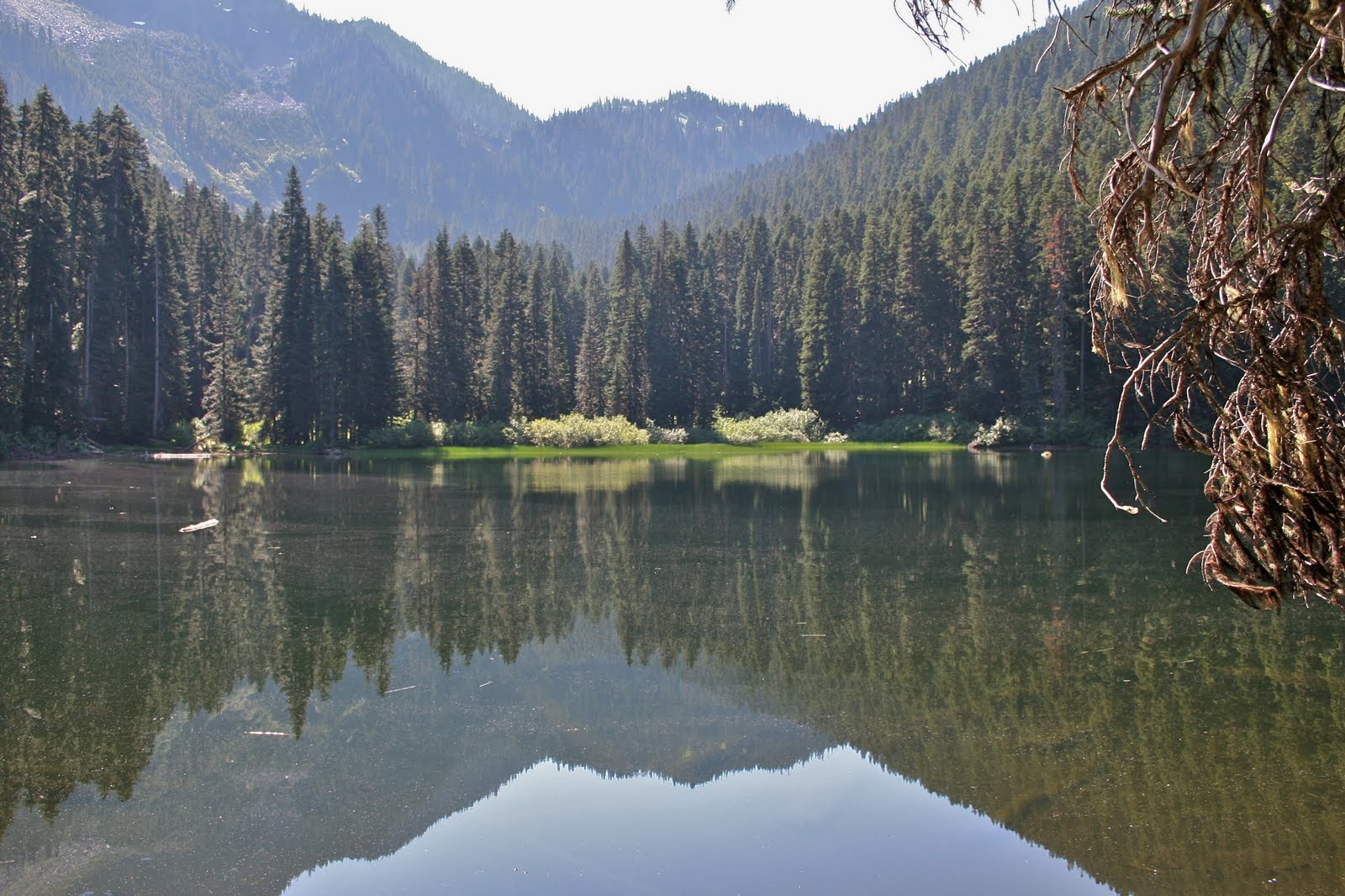
Located just east of Stevens Pass, Lanham Lake (above) sits at the base of Jim Hill Mountain, one of two peaks in the area (the other being Big Jim Mountain on Icicle Ridge) named for James J. Hill, the Great Northern Railroad empire builder.

Trail mate and friend Chuck Ferguson and I hiked the path to the lake, which ascends a steep slope in some big timbers on the Whitepine Creek/Mill Creek divide, on Friday, September 9.

The trail winds through a primeval forest complete with Devil's Club (above), also know as "Devil's Walking Stick." Devil's Club generally grows to three to four feet tall, but can reach a height of 16 feet in rainforest gullies like the Napeequa River.

Some years back, a group of us were dispatched up the Napeequa River, which lies in the Glacier Peak Wilderness, to destroy a squatter's cabin several miles up the river on Forest Service land.

The Devil's Club was over 10 feet tall and -- along with huge patches of vine maple and groves of huge old growth western red cedar -- the scene resembled a prehistoric set straight out of Jurassic Park; I kept thinking I might see a triceratops or a pterodactyl at any moment.

Devil's Club is one shrub you don't want to grab during your walk in the woods. This primordial plant has long, nasty stickers awaiting unsuspecting hikers looking to steady themselves.

As we proceeded up the trail, we crossed through a huge blowdown of large timber across the trail. Chuck said the trail crew has spent days logging out the mess of mountain hemlock and western red cedar that resembled a pile of pick-up sticks.

The cut wood created some interested patterns of pitch (above) that filled the air with a wonderfully pungent aroma.

Our stay was relatively brief considering the amount of time we had spent hiking to Lanham Lake, but the black flies were in fine form, so we took a few pictures and then headed back to the trailhead adjacent to the Stevens Pass Nordic Center.


Saturday, September 3, 2011

Old School

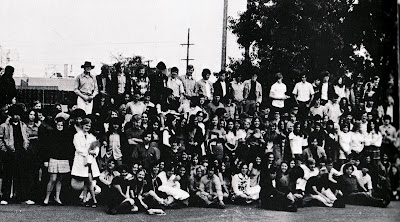
On Sunday, August 21, I spent the day in Portland attending my 40th high school reunion with about 80 of my former classmates from the Lincoln High School Class of '71 (above: that's me in the bottom right, with legs extended in my kick-back-and-relax position).

Although I spent my freshman and sophomore years at Jesuit High School in Beaverton, I transferred to Lincoln -- the oldest high school in the Pacific Northwest -- for my final two years. Established in 1869, Lincoln High School is located in downtown Portland across the street from the iconic Multnomah (now Jen-Weld) Stadium.

To say that Lincoln was a complete switch from Jesuit might be the understatement of the year. An all-boys school, Jesuit prided itself on its academic prowess, which was considerable. Very regimented, the school was governed with a tight grip by the "soldiers of Christ," those priests and noviciates of the Society of Jesus who served as teachers, administrators and coaches at the school. Lincoln, on the other hand, was fresh, progressive, loose, diverse and -- well, let's face it, folks -- less difficult than Jesuit.

It was a better fit for many like myself during the turbulent '60s, when baby boomers came of age following the assassination of President Kennedy, his brother, Bobby and Martin Luther King, along with the Free Speech Movement and Vietnam protests. Plus, there were girls!

Speaking of old schools, the reunion was held at Kennedy Elementary School, another old facility founded in 1915 in Northeast Portland. Owned by those Northwest brewmeisters, the McMenamin brothers, the school is now a popular microbrewery and watering hole that features a movie theater and hotel.

The reunion started at noon, and my goal was to connect with as many people I didn't know in high school as possible -- as well as many I did know. Though well-intentioned, I'm sorry to report that I was unsuccessful in talking to everybody, but I did have have the opportunity to catch up with many of my former classmates.

My high school reunion was, appropriately, quite educational -- a most enjoyable learning experience and one I won't soon forget.