Monday, August 13, 2012

Trekkers Antique Show

Much like John Muir, I find that “going to the mountains is (like) going home” and that “wilderness is a necessity (for) tired, nerve-shaken, over-civilized people.” And so it was on Friday, August 3, I arrived at Owl Farm for an extended backpacking trip up the Buck Creek Trail in the Glacier Peak Wilderness in Washington.

Having convinced buddies Frank Czubiak, Chuck Ferguson and Steve Still to join me on this wilderness hootenanny, we departed Sunday, August 5 for the trailhead at the old mining community of Trinity. Our goal was to reach Buck Creek Pass, where the views of Glacier Peak (above) and the Dakobed Range are stunning.

A. H. Sylvester, the first supervisor of the Wenatchee National Forest, once wrote that of all the many places he had visited in the Cascades, he thought the most beautiful was Buck Creek Pass at the crest of the Cascades. Having been the wilderness ranger for the U.S. Forest Service in the Chiwawa River area in the 1970s, I must agree.

Most of us would be testing updated equipment on this trek –- including new packs, stoves and other gear –- which had me thinking about the evolution of backpacking gear since the 1950s.

Raised in a family who loved to roam the wilds of the Northwest, I started backpacking at a tender age as a Boy Scout in the early 1960s. My first pack was my Dad’s vintage pack board called the “Trapper Nelson" (right/below).

Few will recognize the name of this world-renowned pack as a product of the Pacific Northwest, but before the Trapper Nelson, packs were limp canvas sacks equipped with shoulder straps. Only careful packing prevented the contents from digging into a hiker’s back. What’s more: the weight of the pack would sag down on the hips, and the heavier the load, the more the hiker had to bend forward. Lloyd F. Nelson developed and patented the rigid pack board that bears his name in the 1920s, and he is recognized as the one who eliminated discomfort and added pleasure to backpacking.

Nelson had an epiphany in Alaska when he borrowed a crude Native American pack board made of sealskins stretched over willow sticks. His pack board was innovative for the time; it had a sturdy wood frame to distribute the weight and supported the bulk of the load on the shoulders. A canvas jacket cushions and ventilates the back and a tailor-made canvas bag, which can be removed or replaced in a snap.

I used my Trapper Nelson on numerous excursions, including a 50-mile hike with the Boy Scouts from Timberline Lodge on Mt. Hood to the Columbia Gorge at Cascade Locks.

By the mid-60’s, pack designers had discovered aluminum, so my parents purchased my first regulation Boy Scout pack with an external aluminum frame. By the 80s, I had my first internal frame pack. Today, I sport my “ultralight” rucksack; the current trend, of course, is to “go light.”

Pondering the evolution of backcountry gear, I realized that all four of the intrepid hikers –- with an average age of 60 –- had seen generations of backpacking gear. Was my inspiration a case of “trekker antiques?” Or perhaps it was the “antique trekkers” joining me on this wilderness sojourn. Probably both.

Tuesday, July 31, 2012

Wy'east: Back To The Future

Returning to the mountain of my youth, longtime friend Tom Maloney and I headed north for a wilderness experience and the opportunity to visit with family and friends. Mt. Hood’s imposing presence, particularly with a white winter cape, captivates practically everyone who comes in sight of it, and especially those who live in Portland.

Having spent most of my youth in the forests surrounding Wy’east (as it was known to the Multnomah Indians), my family’s association with the Mt. Hood actually predates my own existence. My grandmother's family had purchased a cabin in nearby Welches near the Salmon River, so my parents spent their youth "on the mountain."

In the early ‘60s, we would camp every summer on the Mt. Hood National Forest. Later, as a Boy Scout, we would “rough it” at various lakes on the mountain's flanks. As part of a climbing group, I reached the summit with my Dad at age 11. I have climbed Mt. Hood another 10 times since, most recently in 2003, when I shot a summit photo (above) of the mountain's shadow at sunrise (coincidentally, with buddy Tom Maloney). We plan to climb the mountain again.

According to local legend, Wy’east (Mt. Hood) was a rival of Klickitat (Mt. Adams) for the love of Loo-Wit (Mt. St. Helens). After a vicious battle of fire and brimstone that must have resembled the end of times to the natives, and ultimately destroyed the Bridge of the Gods over the mighty Columbia River, Klickitat emerged victorious.

The first non-native people to see the mountain were officers in the employ of Captain George Vancouver who had crossed the bar and entered the great river, sailing upriver as far as Rooster Rock. They named the mountain for Lord Samuel Hood, a British naval officer. The first Americans to see Wy'east were Lewis and Clark: “This is the Mt. Hood (of) Vancouver,” they noted in their journals.

Much like the top of the mountain when lenticular clouds circle the summit, it’s not clear who actually first scaled Mt. Hood. Joel Palmer is listed as the first to attempt the mountain in 1845, although David Douglas (the Scottish botanist of Douglas fir fame) is credited by some as having first scaled the peak in 1833. Less credible is the claim of the first successful attempt by a group that included Palmer and Thomas Dryer, founding publisher of The Oregonian, in 1854.

The Mazama Climbing Club later discredited this claim and determined that Henry L. Pittock (who succeeded Dryer as owner and publisher of The Oregonian) made the first authenticated climb. Pittock also built the 22-room renaissance revival known as the Pittock Mansion overlooking downtown Portland. His climbing party suffered from snow blindness and minor injuries and had to remain in camp for several days before returning to Portland.

Since then, of course, the mountain has been climbed in every month of the year, by youngsters who could barely toddle to three-legged dogs to septuagenarians in tennis shoes. In the early part of the 20th century, the Forest Service staffed a lookout on the summit. Weddings have been performed up there. People have died up there.

So it was with great anticipation that I returned to the mountain for a bit of scenery and socializing: a hike up to the summit of Tom Dick and Harry Mountain (above) and a trip to Timberline Lodge before hooking up with my sister Carla and husband Bob –- who own a home in Welches on the Salmon River –- for dinner at the Zigzag Inn.

After a trip into Portland to visit with Iona Maloney, the 95-year-old matriarch of the family, and longtime friend Greg Seymour, we went back up the mountain to Brightwood for a Taylor family reunion in honor of friends Pat and Sharon Taylor. All told, a great trip back to the mountain; it was all the motivation I needed to get back there in the future -- and sooner than later.

Tuesday, July 24, 2012

Lowder Mountain

In an effort to get a few conditioning hikes in before disappearing into the wilderness later this summer, frequent hiking partner and friend Steve Still and I ventured up the Lowder Mountain (above) trail in the McKenzie River Valley on Wednesday, July 15.

Starting above Cougar Reservoir at Quaking Aspen Swamp (yes, there were a few mosquitoes) the trail enters the Three Sisters Wilderness and continues for about three miles to the summit. Wildflowers –- such as the paintbrush below –- were in abundance.

The flat, open top of Lowder Mountain at first seemed like any high-elevation meadow rimmed with Pacific silver fir and mountain hemlock until we ventured to the east side of the summit for a peak at its precipitous cliffs and a view of the Three Sisters.

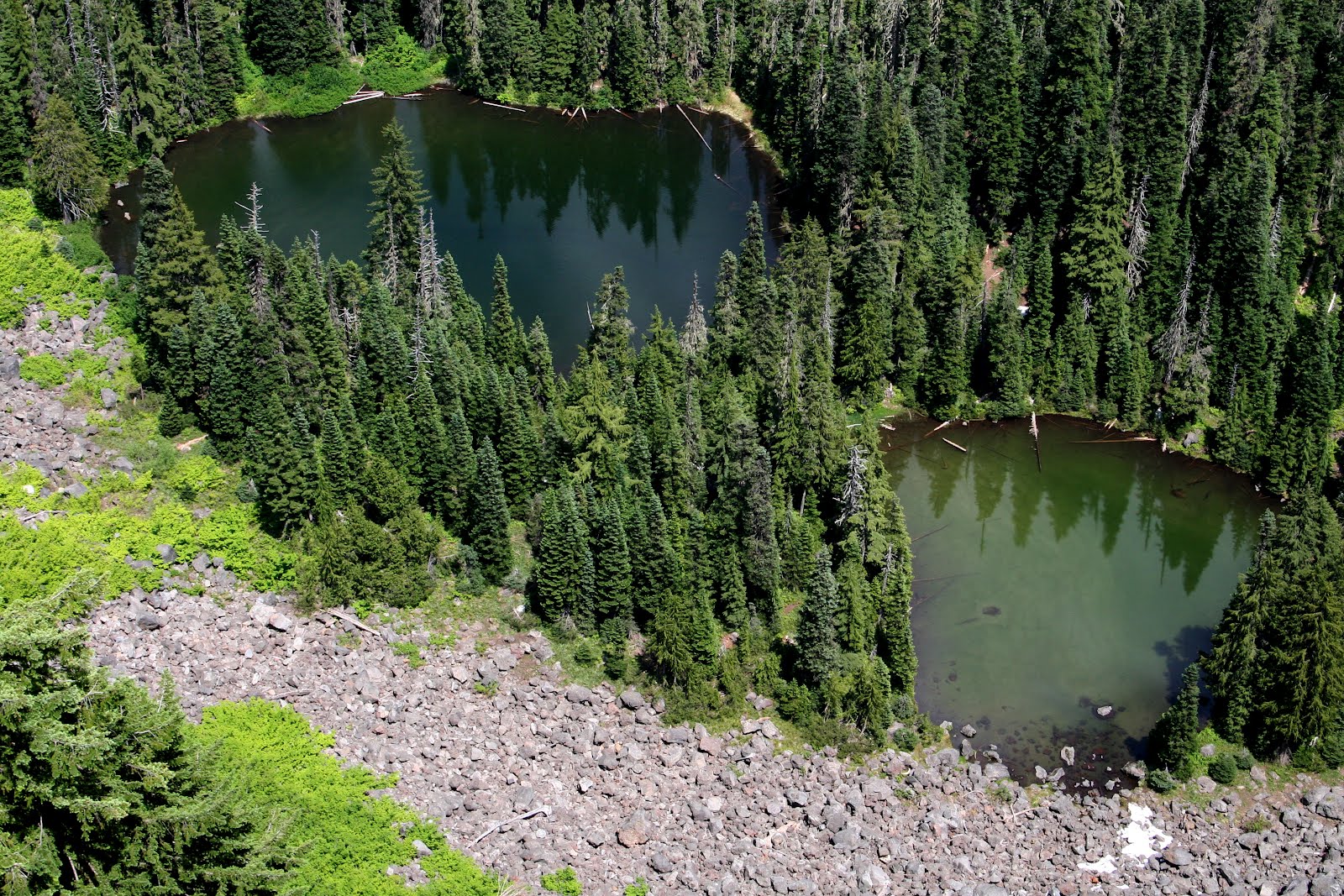
At the base of the cliffs at Lowder Mountain are two lakes -– Lake Karl and Lake Ruth -– that sparkled about 1,000 feet below. The six-mile hike had about a decent elevation gain (and loss) and was a perfect conditioning trip with rewarding views.